Can people with disabilities go for Gorilla Trekking in Uganda? A Complete Guide to Accessible Gorilla Trekking with Peku Adventures
Yes, people with disabilities can go gorilla trekking in Uganda, including travelers who cannot walk independently, wheelchair users, older visitors with limited mobility, and individuals who need physical assistance. Uganda offers specially arranged gorilla trekking experiences that allow visitors with mobility challenges to explore the rainforest and observe endangered mountain gorillas in their natural habitat. Through the use of locally made stretchers, specially designed sedan chairs, and experienced teams of porters, many travelers who cannot manage the difficult forest trails can still enjoy this extraordinary wildlife adventure. The experience requires advance planning, suitable equipment, and an individual assessment of the visitor’s needs, but physical disability does not automatically prevent someone from seeing mountain gorillas.
At Peku Adventures, we believe that the opportunity to experience Uganda’s natural beauty should extend to travelers with different physical abilities. Mountain gorilla trekking often involves walking through dense vegetation, crossing uneven ground, and climbing steep forest slopes. However, visitors who cannot complete these journeys on foot can arrange to be carried through suitable sections of the forest by a dedicated team of local porters. The carriers provide essential mobility support while experienced park rangers guide the group toward a habituated gorilla family. Once the visitors reach the gorillas, they can enjoy the same permitted observation period as other trekkers, subject to park safety rules and the conditions of the encounter.
One of the most important features of accessible gorilla trekking in Uganda is the availability of a special stretcher service. A traditional stretcher can cost approximately US$300 per person for one trek, depending on the equipment, porter arrangements, and trekking location. More elaborate sedan chairs may cost US$400–500 or more. This service is separate from the gorilla trekking permit, accommodation, transportation, and other safari expenses. The US$300 figure is a useful starting price rather than a universal fixed park tariff, and Peku Adventures can help travelers request an updated quotation before booking.
Uganda’s two main mountain gorilla trekking destinations are Bwindi Impenetrable National Park and Mgahinga Gorilla National Park. Both protect remarkable rainforest and mountain ecosystems, providing visitors with opportunities to encounter mountain gorillas under the supervision of Uganda Wildlife Authority personnel. Bwindi is particularly popular because it has several trekking sectors, multiple habituated gorilla families, and a wide selection of nearby accommodation options. Nevertheless, accessibility differs significantly between trails, lodges, vehicles, and individual trekking routes. Peku Adventures therefore recommends organizing every accessible safari around the visitor’s actual mobility needs rather than assuming that all gorilla trekking arrangements are suitable for everyone.
Understanding Gorilla Trekking in Uganda
Accessible gorilla trekking refers to specially planned mountain gorilla tracking experiences that accommodate visitors with disabilities, reduced mobility, or other physical support requirements. Although Uganda’s gorilla forests do not have conventional wheelchair-accessible hiking paths, community porter teams and adapted carrying equipment make it possible for some visitors to travel into terrain they could not manage independently. Instead of completing the entire journey on foot, guests can use stretcher transportation, a sedan chair, or additional porter support. This assistance allows travelers to participate in one of Africa’s most memorable wildlife experiences without having to meet the same physical demands as a conventional hiking group.
The traditional gorilla trekking experience begins at a designated park briefing point, where visitors receive instructions from rangers before entering the forest. During the trek, guides follow established tracking procedures and information from advance trackers to locate a habituated gorilla family. Depending on the location of the animals, weather conditions, and terrain, an ordinary trek may last several hours. For people with disabilities, the journey requires additional coordination because the carrying team must be able to move safely across slippery ground, forest vegetation, and uneven slopes. Park authorities also need to assess whether the planned arrangements are appropriate for that day’s conditions.
Different disabilities require different forms of assistance. A wheelchair user who cannot stand may require a suitable carrying chair, safe transfer procedures, and additional support during the gorilla encounter. Another traveler might walk short distances but need assistance over steep or muddy sections. A guest with limited vision may benefit from a guide who provides detailed verbal descriptions, while someone with a hearing impairment might require written instructions or an agreed communication system. These differences show why accessible tourism should involve practical planning rather than a single solution for every traveler.
Importantly, accessibility does not mean removing all natural challenges from the gorilla trekking experience. Bwindi and Mgahinga remain protected mountain habitats, and their terrain can change quickly after rainfall. Forest paths may become slippery, vegetation can obscure the route, and the position of a gorilla family cannot be guaranteed in advance. Nonetheless, with suitable preparation, qualified assistance, and realistic expectations, travelers with disabilities may be able to enjoy meaningful encounters with these magnificent primates.
Why Uganda Is an Important Destination for Gorilla Trekking for People with Disabilities
Uganda has become an important destination for travelers who want to encounter mountain gorillas while using additional mobility support. The country’s gorilla trekking industry has experience coordinating stretcher and sedan chair services through local porter teams. These arrangements can help visitors with physical disabilities participate in activities that would otherwise be difficult or impossible. Beyond the gorilla encounter itself, Uganda provides opportunities to combine accessible wildlife safaris, cultural experiences, scenic drives, and relaxing accommodation in beautiful natural surroundings.
Bwindi Impenetrable National Park is particularly significant because it protects an important population of endangered mountain gorillas. Its forest contains dramatic valleys, ancient trees, thick vegetation, and mountain slopes that form one of Africa’s most remarkable wildlife habitats. Visitors enter this protected environment under the guidance of experienced rangers who understand gorilla behavior and forest conditions. The experience of watching a mountain gorilla feeding quietly, observing young gorillas playing, or seeing a dominant silverback resting among the vegetation can create memories that last a lifetime.
For travelers with disabilities, the emotional value of this adventure can be especially meaningful. Some visitors may have assumed that gorilla trekking would always be beyond their physical abilities because they cannot hike through steep mountain forests. Discovering that adapted transport arrangements are available may change how they approach wildlife tourism. Rather than excluding themselves from the adventure, they can explore what accommodations and assistance would make the trip practical.
Additionally, accessible gorilla trekking creates employment opportunities for the communities surrounding Uganda’s protected forests. Porter teams provide the physical support necessary for guests who need carrying assistance. Their work generates income for local households and demonstrates the importance of including community members in tourism development. When properly organized, these arrangements benefit visitors while supporting the people who live near gorilla conservation areas.
How Disabled People Are Carried


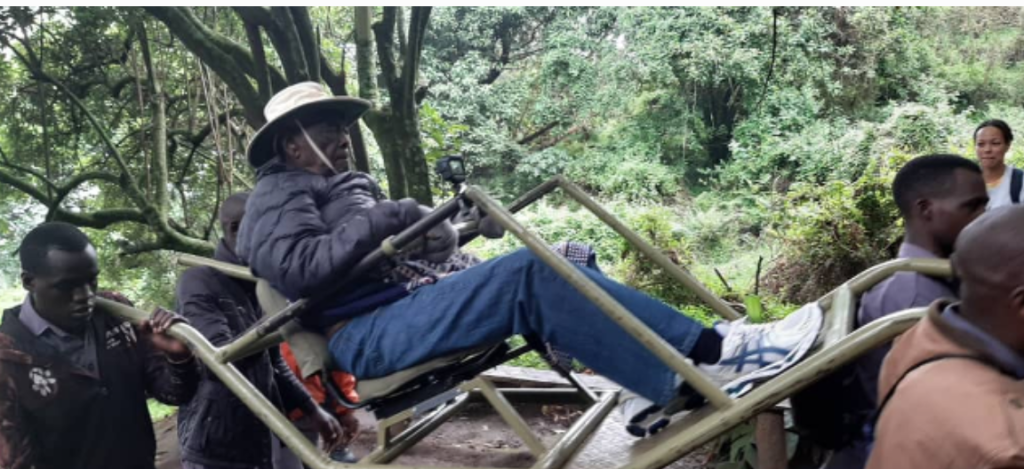
Visitors who cannot walk through the forest may use specially designed carriers known as stretchers or sedan chairs. These devices allow a team of porters to transport a guest along forest routes while park rangers lead the activity. Although the terms are sometimes used interchangeably in tourism descriptions, the equipment can differ considerably in its construction, seating position, support, and comfort. Understanding these differences helps travelers select an arrangement that suits their mobility, transfer requirements, and personal preferences.
Traditional bamboo stretchers are generally locally constructed carriers designed to support a passenger while several porters lift and transport the equipment. Some have a reclining or semi-reclining surface, while others provide a more upright position. Padding, support straps, handles, and other features may vary between individual stretchers. Because there is no single standardized model across all trekking locations, travelers should request photographs and a description of the actual equipment before confirming a booking.
Sedan chairs usually offer a more upright seating position. Certain designs include a backrest, padded seating, carrying poles, and safety restraints. They can provide a suitable alternative for someone who finds a reclining stretcher uncomfortable. Nevertheless, their suitability depends on the visitor’s body measurements, sitting balance, pressure needs, transfer requirements, and the construction of the specific chair. The presence of a seat or safety belt does not automatically make every model appropriate for all disabilities.
During the journey, porters coordinate their movements to transport the guest safely along the selected route. Several people may carry the chair at one time, while others take turns or assist at difficult sections. The number of porters depends on the equipment, passenger requirements, terrain, and local arrangements. Reports describe teams varying from around seven or eight people to twelve or more. Consequently, Peku Adventures recommends confirming the number of assigned porters and the exact service included in the quoted price before arrival.
Once the group approaches the gorilla family, the ranger determines the safest observation position. Porters may help reposition the carrier where the ground and wildlife conditions permit. Visitors can then watch the gorillas from a suitable location while following instructions concerning observation distance, noise, photography, and conservation. No guest should expect to be placed at a particular distance or viewpoint if the ranger considers that position unsafe.
Gorilla Trekking Using a Stretcher in the mist
A stretcher-assisted gorilla trek in Bwindi is arranged for visitors who need to be carried through the rainforest because walking is difficult or impossible. The experience follows the main principles of regular gorilla trekking, including permit requirements, ranger supervision, and limited observation time with a habituated mountain gorilla family. What changes is the method of transporting the guest through the forest and the amount of planning needed before the trekking date.
On the morning of the activity, the visitor arrives at the assigned briefing station. The porter team prepares the stretcher and confirms the carrying arrangements. Before entering the forest, the guest should have an opportunity to check the equipment and discuss any discomfort, positioning needs, or concerns. For people who require assisted transfers, their companion or qualified caregiver may need to explain the safest transfer method. These conversations are particularly important for travelers with limited trunk control, spinal injuries, joint restrictions, or a need for regular repositioning.
After the briefing, the ranger determines when the group can proceed. Depending on the chosen route, the journey may begin along a relatively open section before entering denser vegetation. As the forest changes, porters adjust their pace and movement to manage the terrain. The team may need to stop periodically to rest, change carrying positions, or allow the visitor to make a comfort adjustment. Although the visitor is being carried, the trek can still feel physically demanding because of movement, changing body position, weather, and the duration of the journey.
A properly planned stretcher-assisted trek should never rely on speed alone. Safety, passenger comfort, porter welfare, and respect for the gorillas remain the primary considerations. The selected equipment must be inspected, and the carrying team should understand the guest’s needs before setting off. Suitable clothing, rain protection, and accessible drinking water can help improve the experience.
When the gorillas are located, guests usually receive up to one hour of observation time. The exact encounter depends on the position and behavior of the animals, the safety of the surrounding terrain, and instructions from the rangers. Afterward, the porters carry the visitor back to the designated finishing point, where the Peku Adventures driver-guide can assist with the onward transfer to the lodge.
How Much Does a Gorilla Trekking Stretcher Cost in Uganda?
The approximate starting cost of a traditional gorilla trekking stretcher is US$300 per person for one trekking activity. This is the amount commonly associated with locally made carrying equipment and the accompanying porter service. The final price may be higher if the guest requires a different chair, additional workers, specialized positioning arrangements, or a more demanding carrying route. Unlike the national park gorilla permit, stretcher transportation is generally organized separately through local service providers rather than sold as a fixed Uganda Wildlife Authority tariff.
INDICATIVE COSTS — USD PER PERSON
Traditional stretcher
$300
Starting estimate, subject to confirmation
Sedan chair
$400–$500+
Depends on equipment and porter arrangements
The carrying service is charged separately from the gorilla tracking permit, safari transport, accommodation, and personal expenses.
The US$300 price should be understood as an indicative starting rate rather than a guaranteed fee for every visitor. Porter associations and equipment providers may use different charging arrangements depending on the location, type of carrier, and services required. Some quotations combine equipment and the porter team in one price, while others may list certain services separately. Travelers should therefore request a clear written quotation explaining precisely what the amount covers.
For example, a visitor who can comfortably use a traditional bamboo stretcher may receive a lower quotation than someone requiring a larger padded sedan chair with additional support. Likewise, a guest who needs specialist transfer assistance may have requirements that a regular porter team cannot provide. Such circumstances should be discussed before payment rather than discovered at the forest briefing point.
Peku Adventures recommends treating the carrying arrangement as a dedicated service within the safari booking. Our travel-planning process can help guests request confirmation of equipment availability, porter team arrangements, accessibility requirements, and the expected service cost. This approach allows travelers to understand the financial commitment before making the journey to Bwindi.
Gorilla Trekking Permit Prices for Visitors with Disabilities
Travelers with disabilities must obtain a valid gorilla trekking permit before participating in a mountain gorilla tracking experience. The permit provides access to an organized trek led by authorized personnel and allows a visitor to observe a habituated gorilla family for up to one hour, subject to park conditions and conservation rules. The price depends on the traveler’s nationality or residency category rather than whether the visitor requires mobility assistance.
Under Uganda Wildlife Authority’s published tariff structure, a standard gorilla tracking permit for a foreign non-resident costs US$800. Foreign residents pay US$700, while qualifying visitors from other African countries outside the East African Community pay US$500. East African Community citizens pay UGX 300,000, subject to the authority’s eligibility and documentation requirements. Uganda Wildlife Authority has also introduced selected low-season discounts, including a US$600 foreign non-resident gorilla permit during April, May, and November. Visitors should confirm the applicable tariff and permit availability for their exact dates before committing to a safari.
For guests who require stretcher transportation, the permit and carrying service are two separate charges. Paying US$300 for a stretcher does not replace the gorilla permit. Likewise, purchasing a gorilla permit does not automatically provide a special carrier, a porter team, or the additional assistance needed to complete the forest journey. Both services must be arranged appropriately.
Estimated Cost of an Accessible Gorilla Trek
| Service | Estimated cost |
|---|---|
| Gorilla permit for a foreign non-resident | US$800 |
| Traditional stretcher and carrying team | From US$300 |
| Estimated combined amount | From US$1,100 |
| Optional upgraded sedan chair | Quoted separately |
| Accessible accommodation | Depends on lodge |
| Private safari transportation | Depends on itinerary |
| Specialist personal care assistance | If required, quoted separately |
A foreign non-resident traveling during an eligible discounted period might pay US$600 for the gorilla permit, bringing the combined permit and US$300 starting stretcher estimate to US$900. However, that illustration excludes other safari expenses and assumes the selected dates, permit category, and stretcher quotation qualify for those amounts. An accessible vehicle, suitable accommodation, guide services, and personal assistance may add significantly to the overall travel budget.
Peku Adventures encourages visitors to compare complete safari quotations instead of concentrating only on the gorilla permit. A reasonably priced permit offers little practical benefit if the accommodation has inaccessible bathrooms or the vehicle cannot safely accommodate the visitor. Consequently, a complete budget should account for mobility equipment, transfer support, transportation, accommodation, meals, and the level of assistance required throughout the journey.
Traditional Bamboo Stretcher Versus a Modern Sedan Chair
Traditional stretchers and modern sedan chairs serve a similar purpose, but their different designs may affect comfort and suitability. A traditional stretcher often provides a relatively simple carrying platform constructed using bamboo, wood, woven materials, or other locally available components. Padding and support features differ between models, so travelers should never assume that every stretcher provides the same level of comfort. Some equipment allows the passenger to recline, while other designs support a semi-seated position.
For visitors who cannot maintain a stable sitting posture, a reclining arrangement may initially seem preferable. However, a flat or semi-flat surface can create different challenges, especially for someone with breathing difficulties, pressure sensitivity, restricted joint movement, or a medical need to remain in a particular position. The best arrangement depends on individual circumstances rather than the appearance or price of the carrier.
Modern sedan chairs frequently provide a more defined seat with a backrest and carrying handles or poles. Some models include a safety belt and additional cushioning. These features can be helpful for guests who prefer an upright position and have sufficient sitting balance. Nevertheless, travelers who require head support, lateral positioning, specialized cushions, or pressure relief should confirm whether those needs can be accommodated. A standard sedan chair is not a medical mobility device, and its suitability should be evaluated accordingly.
Another important consideration is the method of entering and leaving the carrier. Someone who can stand briefly may transfer with assistance, while a visitor who cannot bear weight might need a different procedure. Porters should not be expected to perform a complex medical transfer without suitable training and equipment. Where necessary, a caregiver or qualified assistant should accompany the traveler and agree on a safe method before the trek.
The carrying team must also understand the capacity and stability limits of the chosen equipment. Passenger weight, body dimensions, posture, and the distribution of weight across the carrier all affect safe handling. Confirming these details in advance helps prevent uncomfortable adjustments or unsuitable equipment on trekking morning.
Peku Adventures recommends selecting a stretcher or sedan chair based on personal comfort, practical mobility needs, and confirmed local availability. A lower price does not automatically make a particular carrier the right choice, just as a more expensive chair does not guarantee superior accessibility for every passenger.
Are wheelchairs Accepted?
Yes, some wheelchair users can participate in gorilla trekking in Uganda with suitable carrying arrangements. Although conventional wheelchairs cannot normally travel through Bwindi’s steep forest trails, visitors may transfer into a stretcher or sedan chair for the forest portion of the activity. A porter team then transports the passenger along a suitable route while park rangers supervise the trek. Whether this arrangement is practical depends on the visitor’s individual requirements, available equipment, terrain, and safety assessment.
Wheelchair users have diverse needs and abilities. Some can transfer independently from a wheelchair into another seat, while others require physical assistance or specialized equipment. A visitor who uses a manual wheelchair may have different transportation needs from someone who uses a powered wheelchair. The size and weight of the chair, the availability of an accessible vehicle, and the ability to store or transport mobility equipment should therefore be considered when planning the safari.
During the forest trek, a visitor’s everyday wheelchair will generally remain outside the trekking route because the terrain is not designed for normal wheelchair use. The exact storage or handling arrangement should be confirmed with the guide and trekking team. Guests who rely on their wheelchairs for postural support should discuss whether the available carrier offers a suitable alternative. Without this assessment, a journey that appears accessible in a tourism advertisement may prove uncomfortable or unsafe.
Travelers with spinal cord injuries or reduced sensation need particular attention to seating comfort and pressure management. Extended periods in one position can create problems, especially when the carrier moves over uneven ground. Comfortable cushioning, appropriate positioning, and an agreed plan for any necessary breaks are important. These measures should follow the visitor’s normal care requirements and professional medical advice where relevant.
Accessible accommodation also matters for wheelchair users. Some lodges may advertise accessible rooms even though their bathrooms contain narrow doorways, raised shower entrances, or insufficient maneuvering space. Others may offer ground-floor bedrooms but have steep paths between the restaurant and the accommodation area. Consequently, travelers should confirm room measurements and essential facilities rather than relying only on general accessibility descriptions.
With thoughtful preparation, suitable support, and realistic expectations, wheelchair users can explore possibilities for a rewarding mountain gorilla encounter in Uganda.
Gorilla Trekking for Elderly People Who Cannot Walk Long Distances
Older travelers often express concern about the physical demands of mountain gorilla trekking. Bwindi’s rainforest contains steep slopes, irregular paths, and thick vegetation that can challenge even relatively active visitors. Age-related changes in strength, balance, and endurance may make conventional hiking uncomfortable. However, advanced age alone does not prevent someone from participating in gorilla trekking, provided the visitor meets the relevant park requirements and the planned activity is appropriate for their health and mobility.
A stretcher or sedan chair can offer an alternative for older guests who want to see mountain gorillas but cannot manage several hours of walking. Rather than climbing through the forest independently, they can arrange for porters to carry them along the selected route. This support may help reduce the effort associated with walking, although passengers still experience the movement, vibration, altitude, and outdoor conditions of the journey.
Some elderly visitors can walk on level ground but struggle with steep slopes or slippery paths. For these travelers, additional porter assistance may be more suitable than a full carrying service. A porter can provide physical support, carry personal belongings, and help the guest navigate difficult sections, subject to park guidance. However, visitors who might unexpectedly become unable to walk should not assume that a stretcher will be immediately available unless one has been arranged.
Health considerations deserve careful attention. A traveler with significant heart disease, respiratory problems, recent surgery, or reduced ability to tolerate movement should speak with a qualified healthcare professional before confirming a strenuous outdoor activity. Being carried removes much of the walking requirement, but it does not eliminate physical stress or every medical risk.
Older guests should also consider choosing accommodation close to the trekking briefing point. A shorter morning transfer can reduce fatigue and provide additional time for breakfast, medication, and personal preparation. Comfortable room access, suitable bathroom facilities, and reliable transport can make a considerable difference to the experience.
At Peku Adventures, we encourage older travelers to discuss their actual mobility needs without feeling pressured to demonstrate their fitness. The purpose of arranging additional assistance is to make the journey more manageable while protecting the safety and dignity of everyone involved.
Gorilla Trekking for People with Physical Disabilities
Physical disabilities can affect walking ability, muscle strength, balance, coordination, joint movement, or the use of particular parts of the body. Consequently, two travelers with the same general diagnosis may require completely different forms of assistance. A person who uses crutches might navigate some paths independently, whereas another guest may depend entirely on a wheelchair or a specialized carrier. Accessible gorilla trekking should respond to these individual needs rather than treating disability as a single category.
Visitors with lower-limb disabilities may benefit from stretcher transportation when the forest terrain is too difficult to manage on foot. Others may prefer to walk short distances using their usual mobility aids, supported by experienced porters where appropriate. The chosen arrangement depends on the condition of the trails, the visitor’s balance, and whether the mobility aids can be used safely within the forest. Ordinary hiking sticks may help some people, but they cannot replace properly planned assistance for someone with substantial mobility restrictions.
Individuals with upper-limb disabilities may have little difficulty walking but require support with carrying belongings, maintaining balance, or operating camera equipment. Similarly, people with restricted hand movement may need a companion to assist with personal items during the gorilla encounter. Such arrangements are often easier to organize when the tour operator understands the guest’s needs well before the safari.
For travelers with muscle weakness, fatigue-related conditions, or reduced endurance, the most important challenge may be uncertainty about how long the trek will last. A gorilla family can move during the morning, and its location may change from day to day. Because the duration cannot be guaranteed, guests should avoid planning around an assumed short walking time.
People with complex mobility requirements may need to travel with a personal caregiver. Local porter teams provide carrying assistance but should not be regarded as substitutes for nurses, physiotherapists, or specialist personal support workers. A caregiver who understands the visitor’s needs can assist with positioning, medication, communication, and any other established care arrangements.
An accessible gorilla safari becomes more practical when the travel team understands these requirements before making reservations. Early planning provides time to examine suitable routes, equipment, accommodation, and transportation options.
Visual Impairments people on Gorilla Trekking
People with visual impairments may also participate in gorilla trekking, provided they can access the forest safely and receive appropriate guidance. Not every visitor with a disability requires a stretcher. A person with partial sight may walk with the assistance of a guide, while someone who is blind may need detailed verbal instructions, reliable orientation support, and assistance navigating difficult ground. The type of support required depends on the visitor’s preferences, confidence, mobility, and the terrain.
Although mountain gorilla tourism often emphasizes photography and visual observation, the rainforest offers a rich sensory experience. Visitors can hear birds calling in the forest, leaves moving in the wind, insects in the vegetation, and sometimes sounds made by gorillas. The cool air, changing forest scents, and surrounding natural environment create a powerful atmosphere that can be appreciated through several senses.
A knowledgeable guide can help describe gorilla behavior during the encounter. Rather than simply announcing that the animals are present, the guide may explain where a silverback is sitting, how young gorillas are behaving, or when a mother is holding an infant. These descriptions should be clear, timely, and respectful of the visitor’s preferences.
Safety communication is particularly important when moving through the forest. Guides should provide advance warnings about changes in ground level, obstacles, roots, slippery areas, and narrow sections. Visitors who use white canes or other orientation aids should discuss their preferred guidance methods with the team before entering the park.
Gorillas must never be approached for touching or close physical interaction. Even when a visitor cannot see the animals, normal conservation rules remain in place. Guides can describe the encounter from an appropriate distance without disturbing the gorilla family.
Peku Adventures recommends discussing communication preferences and guiding requirements during the planning stage. With the right assistance, visually impaired visitors can experience the forest in a way that respects their independence and allows them to appreciate the remarkable natural surroundings.
Gorilla Trekking for Travelers with Hearing Impairments
Visitors who are deaf or hard of hearing can enjoy gorilla trekking in Uganda, although communication arrangements should be considered carefully. Park briefings contain important instructions about gorilla behavior, personal safety, trekking procedures, and conservation regulations. A traveler who cannot easily hear spoken explanations may require written information, visual communication, or a qualified sign language interpreter.
Before entering the forest, the guide and visitor should agree on a practical system for exchanging information. Written notes, gestures, and prearranged visual signals may help communicate basic instructions. However, these methods should match the visitor’s preferred way of communicating. When someone relies on a particular sign language, an interpreter who understands that language may be necessary for complete communication.
During the trek, guides sometimes need to provide instructions quickly because of changing terrain or wildlife behavior. A prearranged visual signal can help attract the visitor’s attention before further information is given. Companions may also assist with communication, although they should not automatically be expected to interpret everything unless they agree and have the required skills.
Photography and gorilla observation are often highly enjoyable for visitors with hearing impairments because much of the encounter involves quietly watching animal behavior. Nevertheless, important instructions must remain accessible throughout the activity. Communication planning should therefore cover the entire trekking day rather than only the initial briefing.
When requesting a gorilla safari through Peku Adventures, travelers can explain their preferred language, communication method, and interpreter requirements. This information helps determine whether additional arrangements are needed before the permits and accommodation are confirmed.
Can People with Prosthetic Limbs Go Gorilla Trekking?
Travelers who use prosthetic limbs may be able to complete gorilla trekking on foot, with assistance, or through a combination of walking and carrying arrangements. The appropriate approach depends on the stability and comfort of the prosthesis, the user’s experience on uneven ground, and the conditions of the forest trails. Mountain environments can present challenges because roots, mud, stones, and steep slopes demand careful foot placement and good balance.
A visitor who walks comfortably with a prosthetic leg on ordinary surfaces may still find wet rainforest terrain difficult. Changes in ground angle, fatigue, and uneven surfaces can affect stability. Some travelers may prefer additional support from a porter, while others might consider arranging a stretcher service if their mobility becomes severely limited on challenging trails.
Before the trip, prosthesis users should inspect their equipment and plan for moisture, mud, and prolonged outdoor activity. Suitable footwear, spare components, skin-care supplies, and any necessary maintenance materials may be useful. Personal requirements vary, so travelers should follow advice from their prosthetics specialist where appropriate.
Comfort also matters during vehicle transfers and at the lodge. Repeatedly entering high safari vehicles may be more difficult than moving around level ground. A vehicle with appropriate access arrangements can help reduce unnecessary strain before the trekking day.
No traveler should be pressured to walk simply because they use a prosthetic limb. The most suitable trekking method is the one that matches their mobility, personal preference, and the safety requirements of the activity.
Can People with Chronic Health Conditions Go Gorilla Trekking?
Some travelers with chronic health conditions can enjoy mountain gorilla trekking, but a disability accommodation cannot automatically make the activity medically suitable. The forest environment involves altitude, variable temperatures, wet weather, uneven ground, and potentially lengthy periods away from road access. Even when porters carry a visitor, the journey can involve physical movement and a considerable amount of time outdoors.
For someone managing a long-term condition, the planning process should focus on the specific effects of that condition. Individuals with respiratory difficulties may need to consider the altitude and physical demands of the environment. Travelers who require frequent medication should carry appropriate supplies and understand how they will access them during the trek. People who need specialized medical equipment must determine whether that equipment can be transported safely and operated reliably in forest conditions.
A medical consultation before travel may be advisable for visitors with complex health concerns. The healthcare professional can consider the person’s functional ability, usual medical support, tolerance of prolonged sitting, and potential difficulty accessing medical facilities during the activity. Peku Adventures can assist with travel logistics, but medical clearance and treatment decisions belong to qualified healthcare providers.
Remote locations require extra preparation because specialized care may not be available immediately. Guests should carry necessary medication, maintain suitable medical insurance, and explain emergency arrangements to their travel companions. The safari itinerary should also allow enough rest and recovery time before and after gorilla trekking.
Importantly, travelers should disclose practical support needs without feeling obligated to share unnecessary private medical information. The tour operator generally needs to understand what assistance is required, what equipment must be accommodated, and whether any emergency plan needs to be coordinated. Respecting privacy while obtaining essential logistical information is an important part of responsible accessible tourism.
Uganda’s two mountain gorilla trekking parks

Uganda’s principal gorilla trekking destination, with the Buhoma, Ruhija, Rushaga and Nkuringo sectors. Different routes and equipment arrangements must be assessed individually.

A mountain gorilla trekking alternative in the Virunga volcanic region. Its high-altitude terrain requires careful assessment before planning carried trekking.
Uganda has two national parks where travelers can track habituated mountain gorillas: Bwindi Impenetrable National Park and Mgahinga Gorilla National Park. Both parks lie in the southwestern part of the country and offer unforgettable natural environments. However, the accessibility of a trekking experience depends on the location of the gorillas, the chosen route, the weather, and the availability of suitable porter teams. Neither park should be described as universally wheelchair accessible.
Bwindi has four main trekking sectors: Buhoma, Ruhija, Rushaga, and Nkuringo. Each sector has different terrain, accommodation options, forest conditions, and starting points. Visitors who require carrying assistance should not choose a sector based solely on photographs or the popularity of a particular gorilla family. Instead, the decision should account for practical mobility requirements and advice from the park authorities.
Mgahinga occupies part of the Virunga Mountains near Uganda’s borders with Rwanda and the Democratic Republic of Congo. Its landscapes differ from Bwindi, combining volcanic scenery, montane vegetation, and bamboo habitats. Although some travelers may find its environment appealing, the park’s altitude and mountain terrain create their own accessibility challenges. A stretcher or sedan chair service must therefore be specifically confirmed for the intended date.
The safest planning approach involves considering both parks as possibilities while avoiding promises about short trekking routes. Gorilla families move freely within their habitats, and their positions cannot be guaranteed in advance. Rangers may consider mobility needs when organizing groups, but they must also respect conservation rules, current conditions, and operational requirements.
Buhoma Sector: A Popular Choice for Accessible Gorilla Trekking
Buhoma lies in the northern section of Bwindi Impenetrable National Park and serves as one of the established gateways to the forest. Its history as a major gorilla trekking destination has encouraged the development of accommodation, guiding services, and tourism support within the surrounding community. For some visitors with mobility challenges, Buhoma may be worth considering because its lower-elevation starting area and range of nearby lodges can offer practical planning advantages.
The surrounding landscape features forested hills, local villages, and beautiful green scenery. Travelers staying in Buhoma can enjoy the peaceful atmosphere of the rainforest even when they are not trekking. Depending on their needs, visitors may also participate in carefully selected community experiences or enjoy the scenery from their lodge.
However, Buhoma should not automatically be described as an easy trekking sector. The gorilla families may move considerable distances, and forest slopes can become steep and muddy. A trek that is relatively manageable on one day may be more demanding on another. Consequently, visitors who need a stretcher should confirm the availability of suitable carriers and porter teams rather than assuming that the sector’s popularity guarantees accessibility.
Accommodation selection deserves equal attention. Some lodges offer attractive views but sit on steep hillsides with steps between facilities. For a wheelchair user, an accessible bathroom and a room close to dining facilities may be more important than a panoramic viewpoint. Peku Adventures recommends asking detailed questions about the route from the room to the vehicle, restaurant, and other essential facilities.
Buhoma can be an appealing option for an accessible gorilla safari when its available equipment, accommodation, and trekking arrangements suit the guest’s needs. The final choice should remain flexible until the necessary details have been confirmed.
Rushaga Sector: Gorilla Trekking with Additional Mobility Assistance
Rushaga is situated in the southern part of Bwindi Impenetrable National Park and attracts visitors who want to explore the region’s dense mountain rainforest. The sector is known for its gorilla trekking opportunities and its position within a landscape of green valleys, hills, and rural communities. For guests who require carrying assistance, Rushaga may provide a suitable starting point when the appropriate stretcher equipment and porter arrangements are available.
Some visitors select Rushaga because the broader southern Bwindi region can be combined with excursions around Kisoro and Lake Mutanda. This makes it possible to develop a safari that includes mountain scenery, cultural visits, and relaxation alongside the main gorilla encounter. Nevertheless, the presence of several gorilla families does not guarantee that one will be close to the trekking station on a particular day.
The forest terrain in Rushaga can be demanding. Steep pathways, slippery slopes, and thick vegetation may require considerable effort from the carrying team. During wet conditions, extra caution is necessary to protect passengers and porters. Visitors who require specialist positioning support or additional equipment should discuss those requirements early because not all carriers are identical.
A comfortable lodge near the assigned starting point can improve the overall experience. Arriving the evening before the trek allows guests to prepare their belongings, organize medication, and confirm the next morning’s schedule with their driver-guide.
Peku Adventures can consider Rushaga when designing an accessible Uganda gorilla safari, subject to confirmation that the equipment and local arrangements are suitable for the visitor.
Ruhija Sector: Beautiful Forest Scenery and Important Accessibility Considerations
Ruhija lies in the eastern part of Bwindi and offers a beautiful mountain forest atmosphere. Its elevated position provides impressive views of forested landscapes and surrounding valleys, making the region attractive to travelers who enjoy nature and quiet surroundings. The sector also supports gorilla tracking activities, although its high-elevation environment and uneven terrain require careful planning for visitors with disabilities.
Travelers considering Ruhija should understand that scenic beauty does not necessarily translate into easy physical access. The forest can contain narrow trails, steep sections, and slippery surfaces. Carrying a passenger through such areas may be difficult, especially after heavy rainfall or when the gorillas move into more challenging terrain.
For visitors who require a stretcher, suitability must be determined through discussions with the trekking organizers. The availability of an experienced carrying team, the construction of the chosen equipment, and the guest’s individual mobility needs all influence the decision. It would be misleading to promise that every visitor can complete a carried trek in Ruhija simply because sedan chairs are used elsewhere in Bwindi.
The accommodation environment also deserves careful inspection. Mountain lodges frequently use terraced designs that follow the natural hillside. Although this architecture can provide wonderful views, it may introduce steps and slopes that complicate wheelchair movement.
Ruhija remains a valuable part of the Bwindi trekking landscape. However, travelers with substantial mobility limitations should select it only after the necessary safety and access arrangements have been clearly confirmed.
Nkuringo Sector: Can Disabled Travelers Trek Gorillas Here?
Nkuringo is found in the southern part of Bwindi and is famous for dramatic mountain scenery, forest views, and nearby rural landscapes. Its elevated setting attracts travelers seeking a memorable experience in one of Uganda’s most beautiful regions. However, Nkuringo’s steep terrain can present additional challenges for visitors with significant mobility limitations.
The physical demands of some Nkuringo trekking routes may be greater than those of routes elsewhere in Bwindi. Deep valleys, steep climbs, and uneven ground can make the journey difficult for both walking visitors and carrying teams. While extra porter assistance may sometimes be possible, this should never be taken as a guarantee that a full stretcher-assisted trek can proceed safely.
Travelers who use wheelchairs or require continuous carrying should consult the tour operator before selecting Nkuringo as their trekking sector. Park staff and local providers must assess the practical conditions, equipment, and available assistance. If an alternative sector offers a more appropriate arrangement, it may be sensible to choose that option instead.
The broader Nkuringo region may still have a place in an accessible Uganda safari. Visitors who cannot undertake gorilla trekking there might enjoy scenic drives, carefully arranged lodge experiences, and views of the surrounding landscapes. Such activities should be assessed for accessibility in the same way as the trek itself.
The goal of accessible tourism is not to insist that every destination is suitable for every visitor. Rather, it is to identify realistic opportunities that respect individual needs, natural conditions, and safety.
Mgahinga Gorilla National Park for Travelers with Disabilities
Mgahinga Gorilla National Park lies in southwestern Uganda within the wider Virunga mountain landscape. The park protects mountain gorillas and other wildlife within a remarkable environment shaped by volcanic mountains, montane forest, and bamboo vegetation. For visitors seeking an alternative to Bwindi, Mgahinga offers a distinctive gorilla trekking experience with spectacular scenery.
The park’s volcanic landscape creates different environmental conditions from those found in Bwindi. Some vegetation may be less densely tangled, but the altitude, slopes, and uneven ground can still make walking or carrying difficult. Visitors should not assume that more open forest automatically means an easier journey. Terrain conditions and the gorilla family’s location determine what is practical on the day.
Stretcher or sedan chair assistance may be arranged for some visitors, but the equipment and porter team must be available and approved for the specific plan. Because Mgahinga has different operational characteristics from the four Bwindi sectors, early coordination becomes particularly important.
Travelers combining Mgahinga with accommodation around Kisoro or Lake Mutanda may enjoy scenic drives, community experiences, and relaxation after the gorilla encounter. Nevertheless, access to individual lodges and activities should be checked carefully, especially when visitors require wheelchairs or substantial personal support.
Peku Adventures recommends considering Mgahinga when the guest’s mobility requirements, available carrying arrangements, and planned itinerary make the park a suitable choice.
How to Plan an Accessible Gorilla Trekking Safari
Planning a gorilla trekking safari for a traveler with disabilities requires more detailed preparation than arranging a conventional trekking package. The process begins by understanding the visitor’s mobility needs, preferred method of traveling, personal assistance requirements, and expectations for the experience. Rather than using a standard itinerary for everyone, Peku Adventures recommends building the journey around practical accessibility considerations.
A traveler requesting a stretcher service should explain whether they can transfer independently, maintain an upright sitting position, or require additional physical support. Information about approximate weight and relevant seating dimensions may help determine the suitability of available carriers. Guests should also mention whether they normally travel with a caregiver, use an electric wheelchair, or need specialized equipment during longer journeys. These details should be handled respectfully and used only for organizing appropriate assistance.
Once the requirements are understood, the next consideration is the trekking destination. Bwindi offers several sectors, but the most appropriate choice depends on local carrying services, accommodation access, and the visitor’s specific needs. Peku Adventures can help travelers identify options to investigate before any non-refundable arrangements are made.
Permit availability forms another important part of the planning process. Gorilla permits are limited, and particular dates can become popular during peak travel periods. Accessible travel arrangements may require more preparation, so early reservations are advisable. However, purchasing a permit should not be confused with confirming a suitable stretcher service. Both arrangements need separate verification.
Accommodation and transportation must also be considered together. An accessible lodge is less useful if the vehicle cannot safely accommodate the visitor. Similarly, an appropriately arranged safari vehicle cannot compensate for an unsuitable bathroom or inaccessible sleeping area. The entire journey should therefore be assessed from arrival at the airport to departure.
Finally, guests should receive clear information about confirmed services, additional costs, cancellation terms, and any limitations that remain. Accessible gorilla trekking becomes more enjoyable when travelers understand what has been arranged and what cannot be guaranteed.
Booking a Gorilla Trekking Stretcher in Advance
Stretchers and sedan chairs should be reserved well before the intended trekking date. Unlike ordinary tourism equipment that may be available at short notice, carrying services require coordination with local providers and a suitable team of porters. Demand may also vary between trekking sectors and travel seasons. For these reasons, travelers should avoid arriving at the park without confirming their carrying arrangements.
Early booking allows time to check equipment dimensions, seating arrangements, and the number of porters required. Visitors who need special positioning or transfer assistance may require additional discussions before the service can be confirmed. A travel operator should also ask whether the equipment is suitable for the person’s needs rather than simply reserving the first available chair.
Ideally, guests should begin planning several months before departure, particularly when they intend to travel during the popular June-to-September or December-to-February periods. Shorter-notice arrangements may sometimes be possible, but availability should never be assumed. Accessible accommodation can also be limited, especially in remote areas where most lodges were originally designed without comprehensive wheelchair access.
Written confirmation provides important protection for both the visitor and the service provider. Travelers should know whether the quoted carrying fee includes the porter team, the type of stretcher reserved, and any other agreed assistance. The confirmation should also explain what happens if weather, park conditions, or safety concerns prevent the planned service from operating.
Peku Adventures encourages travelers to finalize essential accessibility arrangements before paying for flights or other expensive non-refundable travel services. This reduces the risk of discovering too late that an important part of the safari cannot be provided.
How Many Porters Carry a Disabled Visitor During Gorilla Trekking?
A stretcher-assisted gorilla trek normally requires several porters who work together to carry the passenger through the forest. The exact number varies according to equipment design, passenger weight, terrain, and the arrangements made by the local carrying provider. Teams may include individuals who lift the chair and others who rotate into carrying positions, provide support, or help negotiate difficult sections.
Some sedan chair arrangements use four people to lift the equipment at one time, with additional porters taking turns during the journey. Other services may organize larger groups, particularly when the route is demanding or the passenger requires additional assistance. Published accounts describe teams of approximately seven to twelve or more, illustrating why a fixed number should not be promised without confirmation.
Communication between the passenger and the porter team is equally important. Before departing, guests should explain any discomfort associated with movement or particular seating positions. The carrying team should understand how the passenger prefers to communicate when they need a break or adjustment.
When planning through Peku Adventures, visitors should request confirmation of how the service will operate, including the number of workers assigned and the assistance included. These details make it easier to prepare for the experience and avoid misunderstandings on the trekking day.
Are Stretcher Services Safe for Disabled Gorilla Trekkers?
Stretcher transportation can make gorilla trekking possible for visitors who cannot hike, but it does not eliminate the natural risks associated with mountain forests. Safety depends on the condition of the equipment, the experience of the carrying team, the suitability of the route, weather conditions, and the visitor’s individual requirements. No tour operator should guarantee that carrying a guest through steep rainforest terrain is completely risk-free.
Equipment should be checked before the journey. Handles, carrying poles, supporting surfaces, straps, and padding must be suitable for the intended use. A passenger should never be placed in a carrier that cannot support their weight or provide an appropriate sitting or reclining position. If specialist equipment is required, its availability must be confirmed in advance.
Forest conditions can change rapidly after heavy rainfall. Muddy slopes, exposed roots, and wet vegetation may increase the difficulty of transporting a passenger. Rangers and carrying teams must decide whether continuing is appropriate when conditions become challenging. Visitors should respect these decisions because they protect the passenger, porters, and wildlife.
Personal medical requirements also influence safety. A traveler who experiences difficulty maintaining a particular posture may need additional support. Someone who cannot communicate discomfort easily should agree on a reliable method of signaling their needs. Guests who require medical supervision should arrange that support separately, rather than assuming the porters have clinical training.
Travel insurance is another important consideration. Visitors should examine whether their policies cover gorilla trekking, remote travel, emergency evacuation, and activities involving carried transportation. Insurance policies vary, and coverage should be confirmed directly with the insurer.
A responsible accessible safari aims to reduce foreseeable risks through careful planning, not through unrealistic promises. This practical approach helps visitors make informed choices about participating in the experience.
Can a Disabled Person Spend One Hour with Mountain Gorillas?
Yes. Visitors with disabilities who participate in a standard gorilla tracking activity are normally subject to the same permitted observation period as other visitors. Once the trekking group reaches a habituated gorilla family, the usual maximum viewing time is one hour. This regulation helps limit the amount of daily human contact experienced by the animals and supports their protection
For someone using a stretcher or sedan chair, the observation begins when the group reaches the gorillas and the ranger permits the encounter to proceed. Porters may help position the visitor in a suitable place, provided the terrain and wildlife conditions allow it. The ranger remains responsible for determining the appropriate viewing distance and directing the group.
The encounter can be remarkable. Visitors may observe a silverback sitting quietly among the vegetation, mothers caring for infants, or younger gorillas interacting with one another. Occasionally, the animals move through the forest while feeding. Their behavior is unpredictable, and no particular sighting or photograph can be guaranteed.
A wheelchair user or stretcher passenger may have a different viewing angle from someone standing nearby. Consequently, the guide and porters should consider positioning carefully before the encounter, while respecting the gorillas’ space. Guests should not expect porters to approach the animals more closely for a better photograph.
The one-hour observation period is an opportunity to appreciate the animals without disturbing their natural behavior. Quiet observation, patience, and respect for the ranger’s instructions help protect the experience for both visitors and gorillas.
What Happens When the Gorilla Family Moves During the Encounter?
Mountain gorillas are wild animals that move freely within their forest habitat. Although visitors track habituated families accustomed to carefully controlled human observation, the gorillas continue feeding, resting, and traveling according to their natural behavior. A family may remain in one place for much of an encounter or move through nearby vegetation while the group watches.
For visitors using stretchers, movement creates additional logistical considerations. Rangers determine whether a new viewing position can be reached safely. A carrying team may be able to make a small adjustment, but a steep slope or narrow section could prevent further movement. The safety of the passenger and the protection of the gorillas take priority over following the family.
Travelers should therefore understand that their viewing position may sometimes be more limited than that of a walking visitor. This does not necessarily reduce the emotional value of the experience, but realistic expectations are important. The forest environment cannot be adapted in the same way as a building or paved tourist attraction.
Photography may also require flexibility. Dense vegetation can obscure parts of the animals, while changing light conditions affect picture quality. Visitors should enjoy the encounter even when perfect photographs are not possible.
Peku Adventures encourages guests to view gorilla trekking as an opportunity to experience wildlife naturally rather than a staged viewing session. The unpredictability of the encounter is part of what makes mountain gorilla tourism so special.
Gorilla Trekking Rules for Visitors with Disabilities
All visitors must follow the conservation and safety regulations governing mountain gorilla trekking. Disability accommodations can change how a guest travels through the forest, but they do not remove the rules designed to protect the gorillas, tourists, and park personnel.
Uganda Wildlife Authority requires gorilla trekkers to meet the minimum age of 15 years. The same age requirement applies to guests using stretchers or other mobility equipment. Visitors must also follow the instructions provided during the briefing and comply with directions from authorized rangers throughout the activity.
Gorillas are genetically close to humans and can be vulnerable to infectious diseases. Visitors who are ill, especially with symptoms of a potentially transmissible illness, should inform the park authorities and avoid exposing the animals. Any applicable mask requirements, minimum viewing distances, and other protective measures must be respected.
During the encounter, guests should remain calm, avoid sudden movements, and keep noise to a minimum. Flash photography should not be used, and touching or feeding gorillas is prohibited. Food and drinks should remain packed away when observing the animals. Visitors should never attempt to attract a gorilla by making sounds or gestures for photographs.
Stretcher passengers must also respect ranger instructions. Remaining seated or securely positioned can help prevent sudden movement, while the porter team should avoid unnecessary repositioning near the animals. If a gorilla approaches, visitors should follow the guide’s directions rather than trying to move closer or retreat independently.
These regulations protect the animals and support the long-term sustainability of mountain gorilla tourism. By following them, travelers with different abilities contribute to conservation while enjoying their experience.
What Is the Best Time for Disabled People to Go Gorilla Trekking in Uganda?
Uganda offers gorilla trekking throughout the year, but seasonal weather can influence the accessibility of forest routes. Visitors with disabilities should consider rainfall, trail conditions, accommodation availability, and personal comfort when selecting travel dates. Although no month guarantees dry conditions, some periods are generally more favorable for outdoor travel.
The months from June to September often provide relatively drier conditions in southwestern Uganda. This period is popular with travelers because reduced rainfall can make some forest paths less muddy. For visitors using stretchers, firmer ground may help the carrying team navigate certain sections more comfortably. However, Bwindi is a rainforest, and rain can occur even during comparatively dry months.
December to February is another period commonly associated with relatively favorable trekking conditions. Travelers may enjoy pleasant opportunities for wildlife activities, scenic drives, and photography. Nevertheless, temperatures can vary with altitude, and early mornings may feel cool in the mountain regions.
March to May typically brings increased rainfall to many parts of Uganda. During wetter periods, paths can become slippery, and the carrying team may face greater difficulty on steep slopes. Although the forest remains beautiful and green, visitors with substantial mobility needs should carefully consider whether these conditions suit their requirements.
October and November may also experience considerable rainfall, depending on the year and location. However, November offers a discounted gorilla permit period under Uganda Wildlife Authority’s announced low-season arrangements. The financial saving may appeal to some travelers, but accessibility and safety should remain more important than the reduced permit price.
Peku Adventures generally recommends considering relatively drier travel periods for guests who require full stretcher transportation. The final decision should account for personal needs, budget, equipment availability, and current conditions rather than assuming that a particular month will always provide easy trekking.
What to consider
Packing for an accessible gorilla safari requires attention to personal comfort, weather protection, and practical mobility needs. The appropriate items depend on whether the visitor will walk with assistance, travel in a stretcher, or use a sedan chair. Because southwestern Uganda’s mountain forests can be cool, wet, and muddy, clothing should provide protection without making movement or transfers unnecessarily difficult.
A lightweight waterproof jacket can help protect against unexpected rain. Long-sleeved clothing and comfortable trousers may reduce exposure to vegetation, insects, and cooler temperatures. Guests who can walk should choose suitable footwear with reliable grip, while stretcher passengers should select footwear that offers comfort and protection during the journey. Warm socks or an additional layer may be useful when sitting for extended periods.
Personal medical supplies should be packed according to the visitor’s usual care plan. Medications, positioning aids, hygiene supplies, and any equipment needed throughout the day should remain accessible. Travelers should also carry enough water and arrange for assistance with drinking when necessary. A small bag managed by a companion or porter can make essential items easier to reach.
For wheelchair users, appropriate cushions and pressure-relief arrangements deserve particular consideration. Standard hiking carriers may not offer the same support as a person’s everyday wheelchair. Any portable supports should be discussed with the carrier provider before travel to ensure they can be used safely.
Camera equipment should be simple to handle during the encounter. Heavy bags and complicated equipment can make the journey less comfortable, especially when a visitor depends on assistance. A lightweight camera or smartphone may provide an easier way to record the experience.
Most importantly, travelers should avoid packing unnecessary belongings for the forest portion of the journey. Essential items should be organized carefully, while other luggage can remain at the lodge or in the safari vehicle.
How Long Does Gorilla Trekking Take for People Using Stretchers?
A conventional gorilla trekking experience can last several hours, depending on the location of the gorilla family and the conditions of the forest. Uganda Wildlife Authority describes gorilla tracking as an activity that may take approximately two to seven hours, including travel through the forest and the gorilla observation period. However, the actual duration varies considerably.
For visitors using a stretcher, the length of the journey may also depend on the pace and rest requirements of the carrying team. Porters need to coordinate their movements carefully, particularly on steep or slippery sections. They may stop periodically to exchange carrying positions, inspect the equipment, or allow the passenger to adjust their posture.
Guests should therefore avoid assuming that being carried will make the trek significantly shorter. A nearby gorilla family may allow a relatively brief journey, but the animals can move before or during the tracking process. Their location cannot be guaranteed when permits are purchased.
Visitors who require medication at regular times, assistance with eating, or particular personal care arrangements should plan for a longer outdoor period. A caregiver or companion may help coordinate these needs, provided all arrangements comply with park rules.
After the gorilla encounter, the group must still return to the starting point or another designated collection location. The return journey can take considerable time, especially when the forest route involves steep climbing.
Peku Adventures encourages guests to reserve the entire day for gorilla trekking and avoid scheduling demanding activities immediately afterward. A relaxed evening at the lodge provides an opportunity to recover, enjoy a meal, and reflect on the experience.
Accessible Accommodation Near Bwindi Impenetrable National Park
Accommodation is one of the most important aspects of planning an accessible gorilla safari. Bwindi has beautiful lodges ranging from relatively simple guesthouses to luxurious rainforest retreats. However, many properties stand on steep hillsides or use terraced designs, which can create challenges for travelers who rely on wheelchairs or have reduced mobility.
A lodge may describe itself as accessible because it has a ground-floor room, but this feature alone does not confirm that the entire property meets a visitor’s needs. Travelers should ask whether the entrance has steps, how wide the bathroom doorway is, whether the shower can be entered without climbing, and whether there is sufficient space beside the bed for transfers.
The route between the guestroom and restaurant is another important consideration. Some properties have steep outdoor paths, gravel surfaces, or multiple staircases. A room that appears suitable internally may still be difficult to reach. Guests should also check whether the lodge provides assistance with luggage or movement between facilities.
For travelers who require personal care support, sufficient room space can be essential. A companion may need to assist with dressing, transfers, or positioning, and cramped accommodation can make these activities difficult. Reliable electricity may also matter for visitors who use powered mobility devices or medical equipment.
Before confirming a booking, Peku Adventures recommends requesting recent photographs, access measurements, and specific information about the facilities required by the guest. Written confirmation helps avoid relying on general descriptions that may not reflect the actual situation.
Comfortable accommodation can greatly improve an accessible safari. After a long day in the rainforest, visitors should be able to rest, use essential facilities, and move around their accommodation without unnecessary difficulty.
Choosing a Safari Vehicle for Travelers with Disabilities
Transportation is a major part of gorilla trekking because Bwindi and Mgahinga are located far from Uganda’s main international airport. Visitors usually travel by road or use a combination of domestic flights and road transfers. The appropriate transport arrangement depends on the itinerary, the guest’s mobility requirements, and the availability of suitable vehicles.
Many conventional Ugandan safari vehicles are built for wildlife viewing rather than full wheelchair accessibility. High steps, narrow doors, and elevated seating positions may create difficulties for travelers who cannot transfer independently. A standard safari Land Cruiser should therefore not be advertised as wheelchair accessible unless its actual features support that claim.
Visitors who use manual wheelchairs may be able to travel in a conventional vehicle if they can transfer safely and their mobility equipment can be stored properly. However, someone who must remain seated in a wheelchair during transport needs a vehicle equipped with suitable wheelchair restraints and passenger safety systems. Safe transport arrangements must be verified rather than improvised.
Powered wheelchairs introduce additional considerations because of their weight, dimensions, battery type, and charging requirements. Road conditions near remote safari destinations can also influence the suitability of different vehicles. Travelers should provide relevant equipment measurements and explain their transport needs before confirming the safari.
Long journeys should include planned rest stops where suitable facilities are available. A visitor who needs assistance with personal care may require more time during transfers than a typical safari schedule allows. Rushing can create unnecessary discomfort and reduce the enjoyment of the journey.
Peku Adventures recommends designing road transfers around realistic travel times and personal requirements. Where a fully adapted vehicle cannot be arranged, the limitations should be explained clearly so that guests can make an informed decision.
Flying to Bwindi for an Accessible Gorilla Safari
Domestic flights can reduce the amount of time spent traveling by road to southwestern Uganda. Depending on available schedules and services, visitors may fly from the Entebbe area to an airstrip serving the Bwindi region, followed by a road transfer to their accommodation. This option can be attractive to travelers who find long vehicle journeys uncomfortable.
However, small domestic aircraft may have limited cabin space, narrow entrances, and specific weight or baggage restrictions. Boarding procedures can differ substantially from those used on large international aircraft. A traveler who relies on a wheelchair, requires substantial assistance, or travels with specialized equipment should confirm accessibility before purchasing a ticket.
Wheelchair users should inform the airline about the dimensions and weight of their equipment. Powered wheelchairs may be subject to additional battery-handling requirements. Passengers who need assistance boarding should ask what support the airline can safely provide at each airport or airstrip.
After landing, the journey continues by road. The vehicle collecting the guest must be suitable for their mobility needs, and the transfer time should be included in the itinerary. An accessible aircraft arrangement alone does not guarantee an accessible journey to the lodge.
Flights are also subject to weather conditions, operational requirements, and airline schedules. Travelers should allow sufficient flexibility, particularly when connecting with international departures or time-sensitive gorilla permits.
Peku Adventures can help visitors compare road and air transfer options based on the practical requirements of their trip. The most comfortable choice depends on personal circumstances rather than the assumption that flying is always easier.
Sample 3-Day Accessible Gorilla Trekking Itinerary with Peku Adventures
A three-day accessible gorilla trekking safari offers an opportunity to visit Bwindi Impenetrable National Park, observe endangered mountain gorillas, and experience Uganda’s beautiful southwestern landscape. This itinerary is designed as an example for visitors who require stretcher transportation or other mobility assistance. The final program must be adjusted to suit the visitor’s requirements, chosen trekking sector, and confirmed accommodation arrangements.
Day 1: Transfer from Entebbe or Kampala to Bwindi Impenetrable National Park
Your accessible Uganda gorilla safari begins with a pickup from Entebbe or Kampala at an agreed time. After meeting your Peku Adventures driver-guide, you begin the journey toward southwestern Uganda. The landscape gradually changes as you travel through rural settlements, farmland, green hills, and beautiful countryside. Your guide can explain the different regions along the way while ensuring that the journey includes suitable breaks.
The drive to Bwindi can take much of the day, depending on the departure point, selected trekking sector, road conditions, and number of stops. For travelers with disabilities, comfort and safety should take priority over maintaining a rigid schedule. Guests who require regular repositioning or personal assistance can discuss their preferred travel routine before departure.
Upon arrival in the Bwindi region, you continue to your selected accommodation. The lodge should have been assessed in advance for the facilities required by the guest. After checking in, you can enjoy the peaceful forest atmosphere, have dinner, and prepare for the next day’s gorilla encounter.
During the evening, your driver-guide reviews the trekking schedule and confirms the planned pickup time. The stretcher service, porter team, and any necessary assistance should already have been arranged before arrival. Travelers may also prepare their clothing, medication, personal care supplies, and camera equipment.
Accommodation: Suitable budget, midrange, or luxury lodge, selected after confirming accessibility requirements.
Meals: Lunch and dinner, depending on package arrangements.
Day 2: Gorilla Trekking Using a Special Stretcher or Sedan Chair
After breakfast, your driver-guide transfers you to the assigned gorilla trekking briefing station. The morning begins with an explanation of park regulations, conservation practices, and the procedures for encountering mountain gorillas. Visitors who require carrying assistance meet the organized porter team and review the equipment before entering the forest.
Once preparations are complete, the ranger directs the group along the selected route. If you cannot walk independently, the porters carry you in the arranged stretcher or sedan chair. They coordinate their movements while navigating the rainforest, allowing appropriate breaks and following instructions from the trekking personnel.
The forest offers a beautiful natural environment filled with ancient trees, rich vegetation, birds, and mountain scenery. As your group moves toward the gorilla family, the guide may explain interesting features of the surrounding ecosystem. The pace remains dependent on safety, terrain, and the needs of the passenger and carrying team.
Eventually, the group may reach the habituated gorilla family identified by the trackers. The ranger selects a suitable viewing position, and visitors enjoy the permitted observation period. Seeing a silverback resting among the vegetation or watching young gorillas interact can be an unforgettable moment.
After the encounter, the carrying team assists with the return journey. Your Peku Adventures driver-guide then transfers you back to the lodge for relaxation. The remainder of the afternoon is left free, allowing you to rest and enjoy the surrounding scenery.
Accommodation: Same lodge in the Bwindi region.
Meals: Breakfast, packed lunch, and dinner.
Main activity: Mountain gorilla trekking using an arranged stretcher or sedan chair.
Day 3: Return to Kampala or Entebbe
Following breakfast, you prepare for the return journey. Your driver-guide assists with luggage and the planned vehicle transfer before departing the Bwindi region. The drive offers another opportunity to appreciate Uganda’s countryside, small towns, agricultural landscapes, and distant hills.
Travelers can request appropriate rest stops along the way. Those with mobility restrictions should agree on suitable stopping locations and assistance arrangements before departure. The journey continues toward Kampala or Entebbe, where the safari concludes at the agreed destination.
An additional night in Entebbe may be helpful for visitors who prefer not to combine a long road transfer with an international flight on the same day. Such arrangements can make the departure experience more comfortable and reduce the pressure of unexpected traffic or delays.
Meals: Breakfast and lunch, depending on the package.
Safari ends: Entebbe or Kampala.
Sample 5-Day Comfortable Gorilla Trekking Safari for Travelers with Disabilities
Travelers who prefer a slower itinerary may find a five-day gorilla safari more suitable. Additional time allows for shorter daily activities, greater flexibility, and a more relaxed experience before and after the main trek.
Day 1: Arrival at Entebbe International Airport
Upon arrival at Entebbe International Airport, you meet your arranged representative and transfer to your accommodation. This first day provides an opportunity to recover from international travel and become familiar with the local environment. The hotel should be selected according to your mobility requirements, including bedroom access, bathroom facilities, and any necessary personal support.
After settling into your room, you may enjoy a relaxed meal and receive a briefing about the upcoming safari. Your travel representative can review the transfer arrangements, accommodation details, and confirmed stretcher booking.
Day 2: Travel to Bwindi Impenetrable National Park
Following breakfast, you depart for southwestern Uganda. The journey passes through changing landscapes, local communities, and agricultural regions. Suitable breaks are included according to the traveler’s requirements.
Upon reaching the Bwindi area, you check into your selected lodge. The evening is reserved for relaxation and preparation for the gorilla trekking experience.
Day 3: Accessible Gorilla Trekking Experience
Today is the highlight of your Uganda safari. After breakfast, you travel to the designated gorilla trekking starting point, where park rangers provide a briefing and the porter team prepares the arranged carrier.
With the necessary mobility assistance, you begin the journey into the rainforest. The carrying team follows the instructions of the rangers and moves through the terrain at a suitable pace. Once the gorilla family is located and the ranger permits viewing, you enjoy the remarkable experience of observing the animals in their natural habitat.
After returning from the forest, you transfer to the lodge for rest. The afternoon remains free, allowing you to enjoy the peaceful surroundings without another demanding activity.
Day 4: Relaxation and an Optional Accessible Community Experience
The fourth day provides time to recover and enjoy the scenery around Bwindi. Depending on your preferences and the accessibility of available activities, you may visit a nearby community project, take a scenic drive, or relax at the lodge.
Some community experiences involve uneven paths, steps, or standing for extended periods. For this reason, the exact activity should be assessed and confirmed before it is included in the itinerary. Guests who prefer a quiet day can remain at the accommodation and enjoy the surrounding forest views.
Day 5: Return to Entebbe
After breakfast, you begin your journey back to Entebbe. Suitable rest stops are arranged along the route, with attention to comfort and individual mobility needs.
Upon arrival, your Peku Adventures safari concludes at the agreed location. Travelers with evening or next-day international flights can arrange additional accommodation if necessary.
Estimated Accessible Gorilla Safari Costs
The total cost of an accessible gorilla safari depends on the number of travelers, accommodation standard, transport requirements, gorilla permit category, and individual assistance needs. Instead of offering a single price that may not reflect the visitor’s circumstances, it is more useful to separate the main expenses.
The following table provides an example of the costs that may be included in a safari for a foreign non-resident visitor using a traditional stretcher.
| Expense | Budget planning estimate |
|---|---|
| Standard gorilla trekking permit | $800 |
| Traditional stretcher with porter team | From $300 |
| Two nights’ accommodation | Quoted according to lodge |
| Three-day safari transport | Quoted according to vehicle |
| Meals and drinking water | According to package |
| Driver-guide services | According to package |
| Specialist personal assistance | If required |
| Total safari price | Personalized quotation |
These amounts are planning illustrations, not a confirmed Peku Adventures package price. The final quotation should specify the actual accommodation, transport, equipment, and assistance being provided.
Guests who travel with family members or companions may be able to share certain transportation and accommodation expenses. However, each person who participates in gorilla tracking requires the appropriate permit. A traveler using a stretcher also needs a separately arranged carrying service.
Why a Private Safari May Be Better for a Traveler with Disabilities
Private safaris offer greater control over transportation, daily schedules, and accommodation arrangements. For visitors with disabilities, this flexibility can be particularly valuable because personal mobility requirements do not always fit the timetable of a conventional group safari.
A private driver-guide can coordinate agreed rest stops and allow extra time for vehicle transfers. Travelers who need assistance with personal care may also benefit from a less demanding daily schedule. Rather than rushing between destinations, the itinerary can focus on a smaller number of well-planned experiences.
Accommodation selection becomes easier when the trip is designed for a particular guest. A private itinerary can prioritize suitable bathrooms, room access, and proximity to essential facilities instead of relying on whichever rooms are available for a larger group.
Another advantage involves communication. The guest and guide have more opportunities to discuss comfort, preferences, and changes to the plan. This can improve the overall experience, especially when someone requires additional time or assistance during activities.
Nevertheless, a private safari does not automatically guarantee accessibility. The actual services must still be checked carefully. The benefit lies in having greater flexibility to select and coordinate appropriate arrangements.
Can Family Members Join a Disabled Person on a Gorilla Trek?
Yes, family members and companions can join a traveler with disabilities on a gorilla trekking safari, provided they meet the relevant requirements and hold valid permits. Traveling together may make the experience especially meaningful because everyone can share the excitement of encountering mountain gorillas.
Each participating visitor follows the park’s trekking procedures. Family members who can walk usually travel on foot with the ranger-led group, while the guest requiring mobility assistance uses the arranged stretcher or sedan chair. The exact group arrangements remain subject to the park authorities’ decisions.
A companion who understands the traveler’s personal needs can provide valuable assistance. They may help with communication, medication, positioning, or reassurance during the journey. However, ordinary family members should not be expected to perform tasks that require specialist training or equipment.
It is also important to consider the ability of the group to travel at a suitable pace. Rangers coordinate the trek according to conservation rules and the conditions of the forest. Family members should respect the instructions given to the carrying team and avoid interfering with lifting or movement.
Peku Adventures can help families explore suitable private safari arrangements so that the journey accommodates different abilities and interests.
Can Disabled Travelers Combine Gorilla Trekking with a Wildlife Safari?
A gorilla trekking experience can form part of a broader Uganda wildlife safari. Travelers who want to explore more of the country may consider combining Bwindi with a carefully selected national park, scenic destination, or cultural experience. Such journeys provide opportunities to enjoy different landscapes while making the most of the trip to East Africa.
Queen Elizabeth National Park is a popular option because visitors can explore savannah landscapes and enjoy wildlife viewing from a safari vehicle. Depending on available facilities and individual requirements, a boat excursion along the Kazinga Channel may also be worth considering. However, wheelchair access to boats and jetties should be checked before the activity is booked.
Lake Mburo National Park offers beautiful landscapes and wildlife viewing opportunities. Some visitors may enjoy game drives without having to undertake long walks. Nevertheless, the suitability of the vehicle and accommodation should be confirmed carefully.
For guests interested in Murchison Falls National Park, wildlife game drives and certain boat excursions may be appealing. The famous waterfalls provide spectacular scenery, although some viewpoints require walking or navigating uneven ground. Visitors should therefore choose activities that match their abilities rather than assuming that every attraction is accessible.
An accessible Uganda safari can also include relaxing stays near lakes, cultural visits, and scenic drives. The key is selecting experiences that offer enjoyment without creating unnecessary physical demands.
Why Local Porters Are Important for Inclusive Gorilla Tourism
Local porters are an essential part of stretcher-assisted gorilla trekking. Their work provides mobility support for visitors who otherwise might be unable to reach a gorilla family. By transporting passengers through challenging forest conditions, these teams help create opportunities for more inclusive wildlife tourism.
The physical work can be demanding. Carrying a person and their equipment across uneven ground requires coordination, strength, experience, and attention to safety. Porters may need to manage steep slopes, slippery vegetation, and difficult changes in terrain. The importance of their contribution should be reflected in fair payment and respectful working conditions.
Porter services also create employment opportunities for people living near Uganda’s protected forests. Tourism-related income can support households and contribute to local economic activity. This relationship strengthens the connection between wildlife conservation and community livelihoods.
Visitors should remember that porters are individuals providing an important service rather than simply equipment operators. Courteous communication, appropriate rest periods, and respect for their professional judgment help create a positive experience for everyone.
The carrying team must also have the authority to raise safety concerns. If conditions make a particular route unsafe, passengers and organizers should respect the team’s assessment. Responsible tourism protects workers as well as visitors.
Peku Adventures recognizes the value of community participation in Uganda’s safari industry and encourages travelers to appreciate the people who help make these remarkable experiences possible.
Does Disability Affect the Chances of Seeing Mountain Gorillas?
Having a disability does not directly determine whether mountain gorillas will be located during a trekking activity. Gorilla sightings depend on the tracking process, the location of the animals, forest conditions, and other operational factors. Both walking visitors and passengers using stretchers participate in activities involving wild gorillas that move freely through their habitat.
Trackers and rangers use their knowledge of the forest and gorilla movements to locate habituated families. However, the animals do not remain in fixed viewing areas. Consequently, no operator can guarantee their precise location or the amount of time required to reach them.
For visitors using carriers, practical limitations may influence which routes are suitable. If a gorilla family moves into exceptionally difficult terrain, the ranger and carrying team must determine whether it is safe to continue. In some circumstances, the visitor’s mobility arrangements may restrict access to a particular position.
This uncertainty should be discussed before the safari rather than hidden behind promises of guaranteed sightings. A responsible operator explains the natural limitations of the experience while working to arrange suitable assistance.
The opportunity to observe mountain gorillas remains the main attraction, but visitors should appreciate the entire forest adventure. The scenery, sounds of wildlife, fresh mountain air, and knowledge shared by experienced guides contribute to the overall experience.
Is Gorilla Trekking in Rwanda Accessible for Disabled Visitors?
Rwanda also offers mountain gorilla trekking through Volcanoes National Park. Travelers with mobility limitations may be able to participate using additional support, including carried transportation arrangements. However, accessibility services, permit prices, equipment availability, and local procedures differ from those in Uganda.
Rwanda’s standard international gorilla trekking permit is considerably more expensive than Uganda’s standard foreign non-resident permit. Consequently, Uganda may offer a more affordable option for some travelers. Nevertheless, cost should not be the only factor when comparing destinations.
The distance from accommodation to the trekking starting point, route suitability, available carriers, and visitor’s mobility requirements all influence the overall experience. A shorter transfer does not necessarily mean an easier forest journey.
Travelers considering both countries should compare complete quotations that include the gorilla permit, carrying services, accommodation, transport, and personal assistance. The exact accessibility features of the equipment should also be confirmed.
Peku Adventures can help travelers interested in Uganda evaluate whether Bwindi or Mgahinga offers suitable arrangements for their planned experience.
Frequently Asked Questions About Gorilla Trekking for Disabled People
Can a disabled person really see mountain gorillas in Uganda?
Yes. People with disabilities may be able to observe mountain gorillas in Uganda using suitable assistance, including stretchers and sedan chairs. The service must be arranged in advance, and participation depends on individual requirements, equipment availability, and the safety of the selected route.
How much does a stretcher cost for gorilla trekking?
A traditional gorilla trekking stretcher may cost approximately US$300 per person for one trek. The fee can vary according to the type of equipment, porter arrangements, and trekking location. Visitors should request confirmation of the final price before booking.
Does the US$300 stretcher price include the gorilla permit?
No. The carrying service is separate from the gorilla trekking permit. A foreign non-resident visitor generally pays US$800 for a standard Uganda gorilla permit, with eligible low-season discounts available under the announced tariff arrangements.
Can someone who cannot walk at all go gorilla trekking?
Some visitors who cannot walk independently can participate using a suitable stretcher or sedan chair. However, safe transfers, positioning requirements, medical needs, and route conditions must be assessed before the service is confirmed.
Can a wheelchair be taken into Bwindi Forest?
Ordinary wheelchairs are generally unsuitable for the steep, narrow, and uneven gorilla trekking paths. Travelers who use wheelchairs may arrange to transfer into a carrier for the forest portion of the activity.
Do disabled travelers spend the same amount of time with gorillas?
Yes. Visitors participating in standard gorilla trekking generally receive the same maximum observation period of one hour, subject to park rules and circumstances during the encounter.
Are stretcher services available in every Bwindi sector?
Carrying services may be arranged in different parts of Bwindi, but availability and suitability vary. Equipment, porter teams, and the chosen trekking route must be confirmed for the specific sector and travel date.
Which gorilla trekking sector is best for wheelchair users?
Buhoma and Rushaga may be worth investigating because of their established trekking operations and tourism services. Nevertheless, no sector guarantees an easy route, and the best choice depends on the visitor’s needs and confirmed local arrangements.
Can a person with one leg go gorilla trekking?
Yes, depending on their mobility and the conditions of the trek. Some travelers with limb differences may walk independently or with support, while others may prefer a stretcher service.
Can blind people go gorilla trekking?
People with visual impairments may participate with appropriate assistance. Guides can provide support during the trek and describe the surrounding environment and gorilla behavior.
Are there special discounts for disabled gorilla trekkers?
Travelers should not assume that a disability automatically qualifies them for a discounted permit. Published permit rates depend primarily on nationality or residency category and any applicable promotional tariff.
Can someone aged 80 or 90 go gorilla trekking?
Advanced age alone does not automatically prevent participation. The important factors include the visitor’s health, mobility requirements, available assistance, and whether the proposed activity is suitable and safe.
Is the stretcher comfortable?
Comfort depends on the carrier’s construction, padding, seating position, and suitability for the passenger. Travelers should ask about the specific equipment and discuss any additional support requirements before confirming the service.
Can visitors choose between a stretcher and a sedan chair?
Visitors may request a particular type of carrier, but the final choice depends on availability, suitability, and local operating arrangements. Different designs offer different sitting and reclining positions.
How many people carry the stretcher?
The number varies according to equipment, terrain, and passenger requirements. Several porters normally participate, with some carrying the passenger while others rotate or assist.
Can a caregiver join the trekking group?
A caregiver may accompany the visitor subject to normal park requirements and any necessary permit arrangements. Their responsibilities should be agreed in advance, particularly when the guest requires specialist personal assistance.
Will rangers assign a closer gorilla family to a disabled visitor?
Mobility requirements can be communicated to the trekking organizers, who may consider them during planning. However, a nearby gorilla family or shorter route cannot be guaranteed because gorillas move naturally through the forest.
Can a stretcher be booked on the trekking morning?
Visitors should not rely on same-day availability. Carrying equipment and porter teams require advance organization, especially during busy travel periods.
What if it rains during the trek?
Rain can make forest paths slippery and more difficult to navigate. Rangers and porters assess conditions and determine whether the planned route remains safe. Guests should carry appropriate rain protection.
Is gorilla trekking suitable for people with spinal cord injuries?
Participation may be possible for some people with spinal cord injuries, but the carrier, positioning, pressure management, transfer procedures, and medical requirements must be assessed individually. Advice from a qualified healthcare professional may be necessary.
Are there accessible safari lodges near Bwindi?
Some accommodation providers may offer features suitable for travelers with mobility limitations. However, accessibility varies considerably, so the exact facilities should be checked before booking.
Can disabled visitors take photographs of mountain gorillas?
Yes. Visitors may take photographs while following park regulations. Flash photography should be avoided, and guests must respect the ranger’s instructions about positioning and distance.
Can someone use a stretcher for gorilla trekking without a caregiver?
Possibly, depending on the person’s needs. Porter teams provide carrying assistance but do not necessarily provide personal medical care or specialized transfer services. Visitors requiring those services should make separate arrangements.
Can disabled travelers book a luxury gorilla trekking safari?
Yes. A luxury itinerary can include high-quality accommodation, private transport, and other personalized arrangements. However, luxury does not automatically mean fully accessible, so facilities must be assessed individually.
Is gorilla trekking safe for disabled visitors?
An appropriately planned trek may be suitable for some visitors with disabilities. Nevertheless, mountain terrain, weather, physical movement, and personal health needs create risks that must be considered before the activity.
Can children with disabilities go gorilla trekking?
Uganda’s minimum gorilla tracking age is 15 years. A disability does not remove this age requirement, so children younger than the permitted age cannot participate in standard gorilla tracking.
How far in advance should I book an accessible gorilla safari?
Several months of advance planning is advisable, particularly during popular travel seasons. Early arrangements provide time to confirm permits, carrying equipment, accommodation, transportation, and any necessary personal assistance.
What information should I give Peku Adventures before booking?
Travelers should explain their mobility requirements, preferred carrier type, transfer needs, relevant equipment dimensions, approximate weight where necessary for carrier suitability, and any practical assistance required during the journey.
Can a disabled visitor combine gorilla trekking with chimpanzee trekking?
Some travelers may be able to combine these experiences, but chimpanzee tracking takes place in different environments and requires a separate accessibility assessment. Stretcher arrangements available for gorilla trekking should not be assumed to exist for every chimpanzee tracking activity.
Is a three-day gorilla trekking safari enough for a disabled traveler?
A three-day itinerary may work for travelers who can comfortably manage the required transportation and forest activity. However, a longer itinerary may offer more rest, greater flexibility, and a less demanding schedule.
Can Peku Adventures arrange an accessible gorilla trekking safari?
Peku Adventures welcomes inquiries about customized gorilla trekking experiences for travelers with disabilities. The company can help visitors plan suitable safari arrangements, subject to confirmation of equipment, park requirements, accommodation, and local assistance providers.
Why Book an Accessible Gorilla Trekking Safari with Peku Adventures?
Planning a gorilla trekking safari with mobility requirements calls for careful coordination and clear communication. Peku Adventures aims to help travelers explore Uganda’s remarkable wildlife destinations through personalized itinerary planning. Rather than expecting every guest to follow the same program, we encourage visitors to explain their preferences and practical needs so that suitable arrangements can be investigated.
Our safari planning approach focuses on the complete journey, including airport arrival, transportation, accommodation, trekking permits, and available porter services. We understand that a memorable gorilla encounter begins long before reaching the rainforest. Guests need reliable information about what is included, the costs involved, and the limitations of each service.
For visitors requiring stretchers, the starting cost of approximately US$300 provides a useful budgeting reference. However, the actual equipment, porter arrangements, and total price must be confirmed before travel. We encourage guests to select mobility assistance based on comfort and safety rather than price alone.
Peku Adventures also recognizes the importance of local communities in Uganda’s tourism industry. Porter teams provide valuable services that help travelers experience mountain gorilla trekking despite mobility barriers. Supporting these services through responsible arrangements contributes to community livelihoods and the wider tourism economy.
Whether you are a wheelchair user, an older traveler with reduced mobility, or someone who requires additional physical assistance, we welcome the opportunity to discuss your safari plans. Together, we can explore suitable options, identify possible limitations, and work toward an experience that respects your individual needs.
Final Thoughts: Disability Does Not Automatically Prevent Gorilla Trekking in Uganda
The answer to the question, “Can disabled people go gorilla trekking in Uganda?” is yes. Many people with disabilities can enjoy mountain gorilla trekking through specially arranged mobility assistance, including traditional stretchers and sedan chairs carried by local porters. These services have expanded the opportunities available to travelers who cannot independently hike through Uganda’s mountain forests.
A traditional stretcher may cost around US$300 per person for one trek, while alternative sedan chair arrangements may cost more. The carrying fee is separate from the gorilla trekking permit and other safari expenses. Visitors should always confirm the equipment, price, and support arrangements before booking.
Bwindi Impenetrable National Park and Mgahinga Gorilla National Park provide extraordinary opportunities to encounter endangered mountain gorillas. However, the natural terrain remains challenging, and accessibility depends on individual needs, route conditions, and available services. Proper planning is therefore essential.
Through personalized itinerary planning, suitable accommodation, appropriate transportation, and locally arranged carrying support, Peku Adventures can help travelers investigate options for an accessible Uganda gorilla safari.
Physical disability does not have to mean missing the opportunity to experience mountain gorillas. With the right arrangements, this remarkable adventure may be within reach.
Book Your Accessible Gorilla Trekking Experience with Peku Adventures
Discover the beauty of Uganda’s rainforest and the unforgettable experience of observing mountain gorillas in their natural habitat. Whether you need a stretcher, a sedan chair, additional porter assistance, or a carefully planned private safari, Peku Adventures welcomes your inquiry.
Share your preferred travel dates, number of travelers, mobility requirements, and accommodation preferences. We can then explore the arrangements needed for your journey and help you understand the expected costs before you book.
Peku Adventures — Explore Uganda’s Wildlife with Confidence, Comfort, and Care.