Tree-Climbing Lions

Uganda is famous for mountain gorillas, chimpanzees, the source of the Nile, and spectacular national parks, but one of the country’s most unusual wildlife attractions is found in the remote southern part of Queen Elizabeth National Park. Here, visitors may encounter lions doing something that seems almost impossible for animals of their size: climbing trees and spending hours stretched across thick branches above the African savannah.
The tree-climbing lions of Uganda are most closely associated with the Ishasha Sector of Queen Elizabeth National Park. Instead of spending the entire day resting in grass or beneath bushes, these lions have become famous for climbing large trees, particularly trees with strong, accessible branches. Uganda Wildlife Authority identifies Ishasha as the part of Queen Elizabeth National Park best known for this unusual lion behavior.
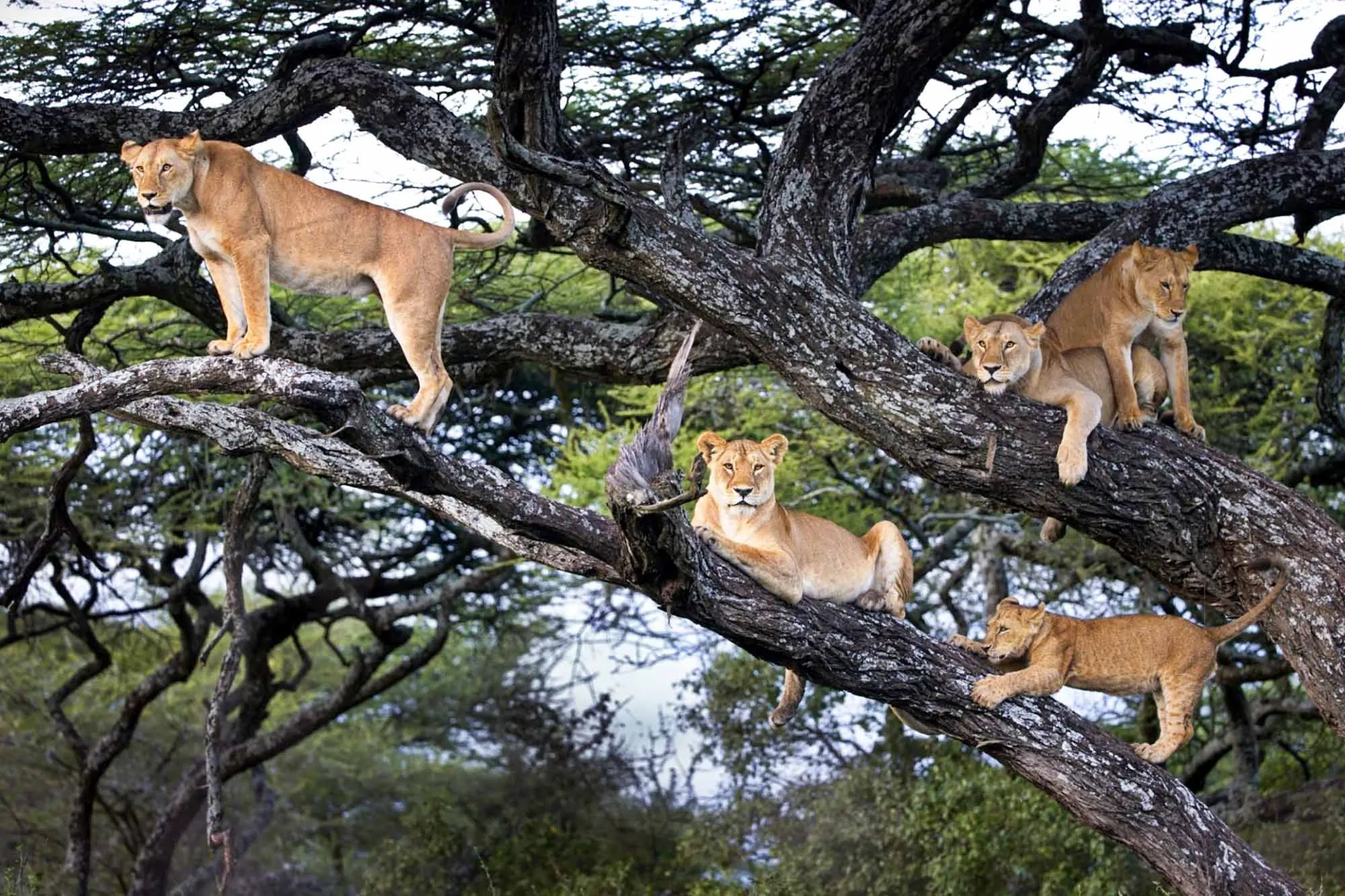
Seeing a lion lying across a tree branch, sometimes with its paws and tail hanging lazily toward the ground, can be one of the most memorable experiences on a Uganda safari. The open plains, scattered trees, distant hills, and other wildlife moving below create a scene that is very different from a typical lion sighting elsewhere in Africa.
However, travelers planning a safari specifically for tree-climbing lions should understand an important reality. These are wild animals, and sightings can never be guaranteed. More importantly, the Ishasha lion population has experienced serious conservation pressure in recent years. In a September 11, 2026 update, Uganda Wildlife Authority reported that only three known adult lions remained in Ishasha, following a sharp population decline associated with human-wildlife conflict and poaching. UWA and the Wildlife Conservation Society have consequently launched a collaborative conservation program intended to support recovery of the population.
For travelers, this makes visiting Ishasha about more than simply taking photographs. It is also an opportunity to understand the importance of protecting one of Uganda’s best-known wildlife populations and supporting conservation-based tourism in the communities surrounding Queen Elizabeth National Park.
Tree-Climbing Lions in Uganda?
The main destination for seeing tree-climbing lions in Uganda is the Ishasha Sector of Queen Elizabeth National Park. Ishasha lies in the southern part of the park and feels noticeably more remote than the better-known safari areas around Kasenyi, Mweya Peninsula and the Kazinga Channel.
Queen Elizabeth National Park itself is one of Uganda’s most diverse safari destinations. Its landscapes include open savannah, wetlands, forests, lakes and the Kazinga Channel. Visitors can encounter elephants, buffaloes, hippos, Uganda kobs, waterbucks, leopards, hyenas and a remarkable variety of birds. The park’s Ishasha Sector adds something especially distinctive to this wildlife experience because of its long association with lions resting in trees.
Ishasha’s landscape is ideal for a slow exploratory game drive. Instead of dense tourist traffic, visitors travel through broad grasslands broken by woodland and large trees. Historically, these trees have provided suitable resting places for the area’s lions. Uganda Wildlife Authority’s Queen Elizabeth Protected Area management documentation specifically notes the importance of fig trees with strong, relatively low branches that allow lions to climb and rest above the ground.
The sector also lies conveniently along an important safari route between Queen Elizabeth National Park and Bwindi Impenetrable National Park. Uganda Wildlife Authority describes the route from Mweya toward Bwindi as passing through Ishasha, creating an opportunity for travelers to search for the tree-climbing lions while moving between a classic savannah safari and a mountain gorilla trekking experience.
This location makes Ishasha particularly attractive for travelers who want to experience several different sides of Uganda within one itinerary. A visitor can watch elephants and buffaloes on the plains, search for lions in the trees, and then continue toward Bwindi’s mountainous rainforest for a completely different wildlife adventure.
Understanding Uganda’s Famous Lions
Lions are capable of climbing trees, but regularly spending long periods resting high above the ground is not typical behavior among most lion populations. That difference is what has made Ishasha so famous.
An adult lion is a large and powerful animal. Its body is designed mainly for life on the ground, where lions hunt, patrol territories, raise their young, and interact with other members of their pride. Watching one carefully balance its weight while moving along a tree trunk therefore creates an unforgettable contrast between the animal’s size and its surprising agility.
The lions of Ishasha became internationally associated with this behavior because visitors repeatedly observed them resting in trees rather than witnessing only occasional climbing. Over time, images of lions stretched along branches became one of the signature photographs of Queen Elizabeth National Park and Uganda’s wider safari industry.
UWA continues to feature the tree-climbing lions of Ishasha among Uganda’s iconic wildlife attractions.
It is worth emphasizing, however, that the term tree-climbing lion does not describe a separate species or special subspecies. These are African lions exhibiting a distinctive behavior. Lions elsewhere in Africa can climb trees as well, and similar behavior is particularly well known from some populations in Tanzania. What has historically made Ishasha remarkable is the regularity with which its resident lions were observed using trees.
For visitors, understanding that difference makes the experience even more interesting. You are not searching for an unusual species of lion; you are hoping to witness an unusual behavior within a familiar species.
Where is ishasha?
One of the most common questions asked by travelers is why lions in Ishasha climb trees so frequently. There is no single explanation that has been conclusively established for every individual lion, and several factors may contribute at the same time.
One commonly discussed explanation is temperature. The open savannah can become very warm during the day. A lion resting on the ground absorbs heat from both the sun and the surrounding earth. A large branch beneath a shaded canopy may provide a cooler resting position where air circulates more freely.
Anyone who has watched lions on safari will quickly understand why comfort matters. Lions can spend many hours resting and conserving energy, particularly after feeding or during the hotter parts of the day. If climbing into a suitable tree provides a more comfortable resting location, the extra effort required to climb may be worthwhile.
Another explanation concerns insects. Biting insects can be irritating to wildlife living on open plains, and resting above ground level may sometimes provide relief. This theory is frequently mentioned in relation to Ishasha’s lions, although travelers should be cautious about treating any single explanation as proven beyond doubt.
Height may also provide a useful vantage point. From a tree, lions can survey open areas of the savannah more easily than when hidden among tall grasses. This does not necessarily mean that they climb specifically to hunt from trees, but being elevated can help them observe movements in the surrounding landscape.
There is also an intriguing behavioral explanation. Young lions learn a great deal by watching other members of their pride. When cubs grow up in a group where adult lions regularly climb trees, the behavior may be copied and passed between generations. In this sense, tree climbing could become partly a local tradition within particular lion groups.
The structure of Ishasha’s trees is another important factor. UWA’s management information notes that fig trees in the sector have strong, low-lying branches suitable for climbing. A lion is much more likely to use a tree if it can reach a sturdy branch without having to climb vertically up a narrow trunk.
Rather than looking for one perfect explanation, it is more realistic to see the behavior as the result of several advantages coming together. Suitable trees, shade, air movement, insects, visibility and learned behavior may all influence when and why an Ishasha lion decides to leave the ground.
What Does a Tree-Climbing Lion Sighting Look Like?
Many safari travelers imagine that lions sit upright in trees like leopards. In reality, the experience can look very different.
A lion may be stretched lengthwise along a broad branch with its stomach resting against the wood. Another may lie across a fork in the tree while its legs hang loosely on either side. Sometimes only a tail, paw, or section of golden fur is visible through the leaves until your guide moves the vehicle to a better angle.
This is why searching for tree-climbing lions requires patience. From a distance, a resting lion can blend surprisingly well with dry branches, shadows and leaves. Experienced guides tend to scan large trees carefully rather than looking only across the grass.
A lion may also be found sleeping on the ground beneath a tree rather than climbing it. Others may be moving through grass, hunting or resting in thick vegetation. Seeing lions in Ishasha therefore does not automatically mean seeing them in trees.
When a lion is found above the ground, however, the sight is extraordinary. Watching an animal normally associated with open grasslands lying several meters above the savannah gives an entirely different impression of lion behavior.
Visitors should resist the temptation to focus entirely on photography. Spend part of the sighting simply observing. Notice how the lion positions its paws, how carefully it shifts its weight, how it reacts to other pride members and how effortlessly it appears to relax despite its unusual location.
Those details often become stronger memories than the photographs themselves.
An Important 2026 Conservation Update for Ishasha
Older safari articles often describe Ishasha’s tree-climbing lions as though travelers can expect to find large prides occupying several trees. Current visitors need more up-to-date information.
On September 11, 2026, Uganda Wildlife Authority and the Wildlife Conservation Society announced the Ishasha Collaborative Management Partnership, a long-term conservation initiative intended to improve protected-area management, strengthen wildlife protection, engage surrounding communities and support recovery of Ishasha’s lions. According to UWA, the lion population had declined sharply because of human-wildlife conflict and poaching, and only three known adult lions remained in Ishasha at the time of the announcement.
This is an important fact for anyone publishing or reading information about where to see tree-climbing lions in Uganda. Ishasha remains Uganda’s famous tree-climbing-lion destination, but travelers should not interpret that reputation as a guarantee of easy sightings.
The conservation situation also demonstrates how fragile wildlife tourism can be. Lions occupy large territories and may come into conflict with livestock owners when they move beyond protected areas. Communities living near wildlife areas may face serious economic losses when livestock is attacked. Successful lion conservation therefore depends not only on protecting animals inside a national park but also on finding practical ways for people and predators to coexist.
According to UWA, the new partnership is intended to strengthen security, protected-area management, community engagement and the wider Ishasha ecosystem while helping restore the lion population.
Travelers can play a role by choosing responsible safari operators, following park regulations, avoiding pressure on guides to approach wildlife too closely and supporting tourism that creates economic value for conservation areas and neighboring communities.
Seeing a tree-climbing lion today should therefore be appreciated not simply as an unusual photograph but as an encounter with a vulnerable and culturally important wildlife population whose future requires active conservation.
Is Ishasha Still Worth Visiting?
Absolutely. Even when lions are difficult to locate, Ishasha remains a beautiful wildlife destination.
One of the greatest pleasures of visiting the sector is its atmosphere. Compared with some heavily visited safari areas, Ishasha can feel open, quiet, and remote. The journey through the plains becomes part of the experience rather than merely a race toward a lion sighting.
Buffaloes may be encountered grazing in groups, elephants can move between wooded areas and open plains, and topi are characteristic animals of this region. Hippos can also occur around waterways, while numerous bird species occupy the grasslands, riverine vegetation and wetlands.
UWA’s protected-area management information describes Ishasha’s riverine woodlands as scenic and wildlife-rich and notes the area’s important topi population.
The possibility of encountering a lion adds excitement, but the safari should not be judged only by whether one is photographed in a tree.
Travelers who approach Ishasha with a broader appreciation of wildlife, landscape, and conservation are more likely to enjoy the experience regardless of what individual animals appear during a particular game drive.
The Best Time of Day to Search for Tree-Climbing Lions
There is no guaranteed hour when lions suddenly climb into trees. Wildlife movements depend on weather, recent feeding, prey distribution, disturbance, individual behavior and many other factors.
Early morning remains one of the most rewarding periods for a general safari. Temperatures are cooler, many animals are active, and the low sunlight creates attractive conditions for photography. Lions may still be moving after nighttime activity or settling down for the day.
Later in the morning, rising temperatures may encourage lions to rest. Historically, this has created opportunities to find Ishasha lions lying in shady trees.
Midday is unusual because many safari destinations become relatively quiet as animals rest. For visitors specifically interested in tree-climbing behavior, however, warmer periods may still be worth exploring because shade and elevated resting places can become attractive to lions.
Late afternoon is another excellent time to be outdoors. The temperature decreases, light becomes softer and wildlife activity can increase again.
The best strategy is not to depend on a single narrow time window. If seeing the lions is a major priority, spend enough time in Ishasha to allow more than one search rather than rushing through the sector during a short transfer.
Wildlife photography always involves probability rather than certainty. Giving yourself additional time is one of the few things you can control.
What Is the Best Season to See Tree-Climbing Lions in Uganda?
Uganda can be visited throughout the year, and Queen Elizabeth National Park offers wildlife viewing in every season. However, weather conditions influence roads, vegetation, photography, and animal visibility.
During comparatively drier periods, tracks are generally easier to navigate, and vegetation may be less dense in some areas, potentially making wildlife easier to see. Dry conditions can also concentrate animals around dependable water sources.
During wetter periods, Ishasha becomes beautifully green. Clouds can create dramatic landscapes, birdlife can be excellent, and photography may benefit from lush vegetation. On the other hand, rain can make some unpaved roads more difficult and tall grass may occasionally make animals harder to locate.
Visitors planning a safari during wetter weather should travel in an appropriate vehicle. Uganda Wildlife Authority recommends a four-wheel-drive vehicle for routes connecting Queen Elizabeth National Park through Ishasha toward Bwindi, noting that much of this route uses dirt roads.
The most important point is that lion behavior cannot be predicted simply from the month of travel. A dry-season visitor can spend hours searching without finding a lion in a tree, while someone traveling during a wetter month may have a remarkable encounter.
Choose travel dates based on the overall Uganda experience you want, then allow sufficient time for wildlife viewing.
How to Get to the Ishasha Sector
Ishasha is located in southwestern Uganda within the southern part of Queen Elizabeth National Park. It can be included in several common Uganda safari routes.
Travelers coming from the central areas of Queen Elizabeth National Park can drive south toward Ishasha. The journey takes visitors away from the Kazinga Channel and Kasenyi region and into increasingly remote landscapes.
Those continuing toward Bwindi Impenetrable National Park can use Ishasha as a natural link between the two destinations. UWA notes that the Queen Elizabeth–Bwindi route passes through Ishasha and places Ishasha approximately 64 kilometers from the Buhoma side of Bwindi on this route.
This creates one of Uganda’s most attractive wildlife combinations. Visitors can begin with a traditional game safari in Queen Elizabeth National Park, search for lions in Ishasha, and then continue into the rainforest for mountain gorilla trekking.
A four-wheel-drive safari vehicle is strongly recommended, especially when rain has affected road conditions. Distances in Uganda should also be judged by driving time rather than kilometers alone. Dirt roads, wildlife stops, weather and road conditions can make journeys longer than travelers expect.
Rather than treating the drive as wasted time, consider it part of the safari. Southwestern Uganda offers beautiful scenery, changing vegetation, rural communities and frequent wildlife surprises along routes through protected areas.
What to Expect on an Ishasha Game Drive
A game drive in Ishasha usually involves slow exploration rather than traveling quickly from one major attraction to another.
Your guide will watch the road for tracks and scan grasslands, tree lines and large branches. Lion sightings may sometimes be reported between guides, but locating wildlife still requires observation, experience and patience.
Large fig trees deserve particularly careful attention because they have historically provided suitable resting places for lions. UWA has specifically linked Ishasha’s climbing behavior with fig trees that possess strong, low branches.
At first, passengers often search for an entire lion. Experienced wildlife watchers learn to search differently. A rounded golden shape between leaves, a tail hanging below a branch, the curve of a back or an unusually smooth patch among rough branches may reveal an animal that would otherwise be overlooked.
If lions are located, your driver-guide should position the vehicle at a respectful distance and in accordance with park regulations. Visitors should remain patient rather than demanding a closer approach.
The most interesting encounters often develop slowly. A sleeping lion may suddenly raise its head. Another pride member may approach. A lion may reposition itself, carefully descend the trunk or look toward animals moving across the plain.
Those moments cannot be scheduled. They are precisely what makes genuine wildlife viewing so rewarding.
Other Wildlife to See in the Ishasha Sector
Travelers sometimes become so focused on finding tree-climbing lions that they overlook everything else around them.
Queen Elizabeth National Park supports an impressive range of animals. Uganda Wildlife Authority lists elephants, buffaloes, hippos, Uganda kobs, waterbucks, lions, leopards, spotted hyenas and numerous other species within the wider park.
Ishasha itself is particularly associated with topi. These elegant antelopes have long faces, dark markings and a characteristic stance that makes them easy to distinguish once you become familiar with them. UWA’s management documentation notes that the sector’s woody grasslands support an important topi population.
Elephants are another highlight. Watching an elephant family quietly cross the plains can be every bit as memorable as seeing a predator. Buffaloes are frequently impressive as well, particularly when large groups gather together.
Birdwatchers should keep binoculars ready throughout the drive. Queen Elizabeth National Park is exceptionally rich in birdlife, and the changing combination of savannah, wetlands and woodland creates opportunities for many different species. UWA reports more than 600 bird species for the park as a whole.
The best safari mentality is therefore to search for lions while remaining interested in everything else. Nature rarely follows an itinerary, and an unexpected elephant encounter, raptor sighting or dramatic landscape can become the highlight of the day.
Combining Ishasha With the Kazinga Channel
A visit to Ishasha becomes even more rewarding when combined with the central attractions of Queen Elizabeth National Park.
One of the park’s most famous experiences is a boat safari on the Kazinga Channel, the waterway connecting Lake George and Lake Edward. UWA describes the channel as approximately 40 kilometers long and notes that its shores attract hippos, crocodiles, elephants, buffaloes and large numbers of waterbirds.
The contrast between the Kazinga Channel and Ishasha helps visitors appreciate the diversity of Queen Elizabeth National Park.
On the channel, the safari experience revolves around water. Hippos surface beside the boat, elephants may approach the shoreline, and birds gather along the banks.
In Ishasha, the experience becomes a quiet search across savannah and woodland, with particular attention directed toward trees that might conceal resting lions.
Travelers with enough time can also explore the Kasenyi Plains and other parts of the park rather than making Queen Elizabeth a one-night stop.
Allowing at least two different wildlife experiences provides a much fuller understanding of the park than visiting only one sector.
Combining Tree-Climbing Lions With Gorilla Trekking in Bwindi
One of the strongest reasons to include Ishasha in a Uganda itinerary is its position between Queen Elizabeth National Park and Bwindi Impenetrable National Park.
A traveler can begin with savannah wildlife, continue through Ishasha and then move into the highland rainforest for a mountain gorilla trek.
UWA specifically identifies the Queen Elizabeth–Ishasha–Bwindi route as an established way to reach the Buhoma area of Bwindi, recommending a four-wheel-drive vehicle for the largely dirt-road journey.
The change in landscape can be dramatic. One day you may be scanning open grasslands for lions and elephants. Shortly afterward, you are surrounded by dense rainforest, steep hills and towering vegetation while preparing to trek mountain gorillas.
That diversity is one of Uganda’s greatest strengths as a safari destination.
Instead of flying long distances between countries to combine primates and classic African wildlife, travelers can create a varied safari within Uganda itself.
For photographers, the combination is especially attractive. Ishasha offers open landscapes and large mammals while Bwindi provides intimate rainforest scenes and primate photography.
For families, couples, wildlife enthusiasts and first-time African safari travelers, combining the two areas can produce a very complete Uganda wildlife experience.
How Long Should You Spend in Ishasha?
Travelers sometimes make the mistake of treating Ishasha only as a lunch stop while driving between Queen Elizabeth National Park and Bwindi.
That approach is possible, but it provides limited time for searching for lions. Wildlife does not arrange itself according to transfer schedules.
Someone arriving at midday may discover that lions are hidden in thick vegetation or outside the area being searched. Another visitor might encounter them within the first hour.
If tree-climbing lions are an important objective, staying at least one night in or near Ishasha provides more flexibility. It can allow an afternoon game drive followed by another drive the following morning before continuing toward Bwindi or returning to other parts of Queen Elizabeth National Park.
Two nights offer even more time, particularly for photographers and serious wildlife enthusiasts.
Given the current conservation situation and the very small number of known adult Ishasha lions reported by UWA in September 2026, visitors should be especially cautious about building an itinerary around the assumption that a lion sighting is guaranteed.
Think of Ishasha as a wildlife destination with the possibility of seeing an extraordinary behavior rather than as a guaranteed wildlife performance.
That expectation produces a much more rewarding safari experience.
Where to Stay When Visiting Ishasha
Travelers visiting the southern sector can stay within or around the Ishasha area, depending on budget, itinerary, and preferred level of comfort.
The advantage of staying nearby is simple: you spend less time transferring and more time exploring. An early start becomes easier, and you can remain in the area later in the afternoon without facing a long drive to accommodation elsewhere.
UWA tourism information has historically identified Ishasha Wilderness Camp as accommodation serving this remote part of Queen Elizabeth National Park. Accommodation availability, rates and operating status can change, so these should always be checked for your actual travel dates.
Travelers continuing toward Bwindi may also choose accommodation closer to the southern exit of Queen Elizabeth National Park or farther toward Kihihi and Buhoma, depending on the following day’s program.
The decision should not be based only on room price. Consider driving time, meal arrangements, road conditions, the location of your next activity and whether you want an early-morning or late-afternoon game drive.
A lodge that costs slightly more but places you close to your wildlife activities can sometimes provide much better value than inexpensive accommodation requiring several hours of additional driving.
How to Photograph Tree-Climbing Lions
Photographing an Ishasha lion can be surprisingly challenging.
Trees create shadows, branches may cross the animal’s face and bright sky behind the lion can confuse a camera’s exposure. At other times, the lion may be relatively far from the road, making a phone camera less effective than expected.
A camera with a moderate or long telephoto lens is useful because visitors should never rely on getting physically close to wildlife for a photograph.
Patience is more important than equipment. Watch the lion before taking dozens of identical photographs. Look for moments when it raises its head, stretches, looks directly toward the vehicle or changes position.
Try to photograph the surrounding tree as well. A close portrait is attractive, but a wider image showing the lion resting above the savannah tells the story of tree-climbing behavior much more effectively.
Light also matters. Strong midday sun can create harsh shadows, while morning and late-afternoon light usually produces warmer colors and softer contrast.
Avoid making noise to attract the animal’s attention. Wildlife photography should document natural behavior rather than trying to manipulate it.
Most importantly, never ask a guide to approach closer than park rules allow. A good wildlife photograph is not worth disturbing an animal.
What Should You Carry for an Ishasha Safari?
Comfort greatly affects how much you enjoy a long game drive.
Lightweight neutral-colored clothing works well in Uganda’s warm safari areas, while an additional layer can be useful for cooler mornings. A hat, sunscreen and sufficient drinking water are important during sunny conditions.
Binoculars are extremely useful even when your main interest is lions. They help you scan distant tree branches and allow you to enjoy birds and other wildlife without needing the vehicle to move closer.
A camera should be protected from dust, while spare batteries or a power bank can be valuable during a full day away from reliable charging points.
During wetter periods, a light rain jacket can be useful, and camera equipment should have protection against sudden showers.
Travelers should also carry patience. This may sound less practical than sunscreen or binoculars, but it is one of the most important things on safari.
Wildlife viewing rarely follows a strict timetable. Spending several quiet minutes watching an empty landscape can suddenly lead to an extraordinary encounter.
Tree-Climbing Lions and Responsible Tourism
The future of Ishasha’s lions depends on more than protected-area boundaries.
Lions require large territories, healthy prey populations and landscapes where they can move without continually coming into conflict with humans.
Communities living near national parks face challenges that visitors may never see. A farmer whose livestock is attacked by predators experiences wildlife conservation very differently from a tourist who photographs the same predator from a safari vehicle.
This is why conservation strategies increasingly recognize that successful wildlife protection must involve surrounding communities.
UWA says the collaborative management partnership launched with WCS in September 2026 will address wildlife protection, community engagement, management capacity, security and peaceful coexistence while supporting the recovery of Ishasha’s lions.
Tourism can contribute by creating economic value around living wildlife. Park fees, tourism employment, guiding, accommodation, transport, crafts and community tourism can all help connect conservation with livelihoods when systems are managed responsibly.
Visitors also contribute through their behavior.
Following designated tracks reduces habitat damage. Maintaining appropriate wildlife-viewing distances reduces disturbance. Respecting park regulations supports rangers and guides who manage the protected area.
Responsible tourism means understanding that the lion exists for its ecosystem, not for a photograph.
Are Tree-Climbing Lions Dangerous?
Tree-climbing lions remain wild lions.
Being in a tree does not make them tame, accustomed to human touch, or safe to approach on foot.
Visitors should remain inside authorized safari vehicles unless they are in an area where a properly guided activity specifically permits leaving the vehicle.
Never attempt to walk toward a lion for a closer photograph. Never stand directly beneath a lion resting in a tree, and never try to attract its attention using food, calls or sudden movement.
Professional guides understand wildlife behavior and park regulations. Their instructions should always be followed.
A lion may look completely relaxed while sleeping, but its behavior can change rapidly if it feels threatened, surprised or disturbed.
Respect creates both a safer safari and a better wildlife experience.
Do Lions Climb Trees Anywhere Else in Uganda?
Individual lions are physically capable of climbing trees, so occasional climbing behavior should not be treated as something that can occur only within one precise location.
However, when travelers ask where to see tree-climbing lions in Uganda, Ishasha is the destination most strongly and consistently associated with the behavior.
Uganda Wildlife Authority repeatedly identifies the Ishasha Sector of Queen Elizabeth National Park as the country’s iconic tree-climbing-lion location.
Travelers should therefore not book a safari in another Ugandan national park expecting the same type of sighting.
For example, Uganda has lions in other savannah ecosystems, but Ishasha is the place traditionally included in itineraries specifically focused on observing lions in trees.
Even in Ishasha, however, remember that the animals may be on the ground rather than above it.
The attraction is a natural behavior, not a scheduled activity.
Are the Ishasha Lions Different From Other African Lions?
They are lions exhibiting a distinctive local behavior rather than a completely different type of animal.
Their ability to climb does not mean they have developed fundamentally different bodies or become a separate tree-dwelling species.
The interesting difference is behavioral.
This is common throughout the animal world. Populations of the same species can develop different habits depending on their habitat, food, social learning and local environmental conditions.
In Ishasha, generations of lions using suitable trees created an especially visible example of this idea.
For travelers interested in animal behavior, that may actually be more fascinating than seeing a separate species. You are witnessing how intelligent animals can adapt their behavior to a particular landscape.
Can You See Tree-Climbing Lions During a One-Day Queen Elizabeth Safari?
It is possible to visit Ishasha as part of a transfer or short safari, but travelers should understand the limitations.
Queen Elizabeth National Park covers a large area, and Ishasha is separate from the main central tourism zone around Mweya and the Kazinga Channel.
Trying to explore Kasenyi, take a boat cruise, and properly search Ishasha during a very short itinerary can create a rushed experience.
If tree-climbing lions are a priority, dedicate specific time to the southern sector.
A longer itinerary also gives you alternatives. If lions are not located on the first drive, you may have another opportunity the following morning.
Short safaris can still be rewarding, but the less time you spend in a wildlife area, the more your experience depends on luck.
Can Ishasha Be Visited With Children?
A family safari can be an excellent way for children to learn about wildlife and conservation, provided the itinerary matches their ages and patience levels.
Searching for lions can involve long periods of driving without a major sighting. Younger children may therefore enjoy the experience more when the day includes breaks and several different wildlife interests rather than focusing exclusively on one species.
Teach children before the game drive that they must remain quiet when approaching animals and follow the guide’s instructions.
Binoculars can make the experience interactive, encouraging children to search trees and plains for themselves.
Rather than promising them that they will definitely see a lion in a tree, explain that wildlife safaris are about exploring and discovering whatever nature presents.
That lesson often becomes one of the most valuable parts of the trip.
Is Ishasha Better Than the Northern Part of Queen Elizabeth National Park?
The two areas offer different experiences, so they are best viewed as complementary rather than competitors.
The central and northern parts of Queen Elizabeth National Park provide access to attractions such as the Kazinga Channel and important game-viewing landscapes. The Kazinga Channel in particular provides excellent opportunities for viewing hippos, elephants, buffaloes, crocodiles and waterbirds from a boat.
Ishasha feels more remote and is specifically associated with tree-climbing lions and topi.
If time allows, visiting both areas creates a more complete Queen Elizabeth safari.
Travelers with very limited time should choose according to their wider itinerary. Someone continuing toward Bwindi can incorporate Ishasha naturally, while someone traveling north may focus more heavily on Mweya, Kasenyi, and the Kazinga Channel.
Why You Should Never Expect a Guaranteed Lion Sighting
Wildlife tourism advertising sometimes uses phrases that make animals sound predictable. This can create unrealistic expectations.
No ethical safari operator can guarantee that a particular wild lion will be found in a particular tree at a particular time.
Weather changes. Animals move. Lions hunt at night and rest in unexpected areas. They may leave a familiar territory or remain hidden in vegetation.
The current conservation situation in Ishasha makes honest communication particularly important. UWA’s September 2026 report of only three known adult lions in the sector means visitors should be especially cautious about older articles claiming that large prides are easily or consistently found.
A responsible safari operator should explain the reality rather than promise a sighting simply to secure a booking.
That does not reduce the excitement of visiting Ishasha. In many ways, it increases it.
When a genuine wild encounter finally happens after careful searching, the moment feels earned.
What Makes Ishasha Special Even Without the Lions?
There is a deeper reason to visit Ishasha.
It represents a quieter side of Uganda’s safari landscape.
The wide plains, scattered trees and riverine areas create a strong sense of space. Vehicles may travel considerable distances while passengers watch the horizon, listen to birds and search for movement among the grass.
Without constant traffic between sightings, visitors have time to notice smaller details: the shape of a distant antelope, elephant tracks across a road, birds following buffaloes or the silhouettes of fig trees against the sky.
UWA describes the sector as remote and highlights the scenic value of its riverine woodland and its diverse wildlife.
That atmosphere is increasingly valuable in modern tourism.
A safari does not have to involve racing from animal to animal. Ishasha encourages a slower form of wildlife travel where the landscape itself becomes part of the experience.
Frequently Asked Questions About Tree-Climbing Lions in Uganda
Where exactly can I see tree-climbing lions in Uganda?
The main destination is the Ishasha Sector of Queen Elizabeth National Park in southwestern Uganda. Uganda Wildlife Authority identifies Ishasha as the part of the park particularly famous for tree-climbing lions.
Are tree-climbing lions guaranteed in Ishasha?
No. These are completely wild animals, and sightings cannot be guaranteed. The situation is particularly serious in 2026 because UWA reported on September 11 that only three known adult lions remained in Ishasha after a serious decline.
Why do Ishasha lions climb trees?
Several explanations have been suggested, including seeking shade, obtaining better airflow, avoiding some ground-level insects, gaining an elevated view of the surrounding plains, and learning the behavior from other lions. The presence of strong, low branches in Ishasha’s fig trees also makes climbing easier. UWA specifically notes the suitability of the area’s fig trees for this behavior.
What trees do the Ishasha lions climb?
Fig trees are particularly associated with the behavior because their branches can be broad and strong enough to support resting lions. Other suitable trees may also be used depending on their structure.
What is the best time to see tree-climbing lions?
There is no guaranteed time. Early mornings and later afternoons are excellent for general game viewing, while warmer periods may sometimes encourage lions to rest in shaded elevated positions. Spending more than one game drive in Ishasha increases the amount of time available for searching.
Can I see tree-climbing lions while traveling to Bwindi?
Yes. Ishasha lies on a common safari route connecting Queen Elizabeth National Park with the Buhoma side of Bwindi Impenetrable National Park. UWA specifically describes this route as providing an opportunity to search for the iconic tree-climbing lions.
How far is Ishasha from Bwindi?
UWA indicates that Ishasha is approximately 64 kilometers from Buhoma on the route from Queen Elizabeth National Park to Bwindi. Road conditions can significantly affect travel time, so travelers should plan journeys by expected driving time rather than distance alone.
Do I need a 4×4 vehicle?
A four-wheel-drive vehicle is highly recommended for the route through Ishasha toward Bwindi, especially during wet conditions. UWA describes much of the route as dirt road and recommends 4WD transport.
Are there other animals in Ishasha?
Yes. Ishasha supports buffaloes, elephants, topi, hippos, and numerous birds, among other wildlife. The wider Queen Elizabeth National Park ecosystem also contains Uganda kobs, waterbucks, leopards, hyenas and many other species.
Can I combine Ishasha with a Kazinga Channel boat cruise?
Yes, and this is one of the best ways to experience Queen Elizabeth National Park. The Kazinga Channel provides excellent water-based wildlife viewing, while Ishasha offers savannah game drives and the possibility of observing tree-climbing lions.
How many days should I spend in Queen Elizabeth National Park?
A short visit can provide a good introduction, but travelers wanting to experience the Kazinga Channel, general game drives, and Ishasha should allow sufficient time for the different sectors. Adding an overnight stay around Ishasha is particularly useful if the lions are a major priority.
Can I see lions in other parts of Queen Elizabeth National Park?
Yes. Lions occur in other parts of the park as well. Ishasha is special because it is associated specifically with the tree-climbing behavior.
Is it safe to get out of the vehicle near tree-climbing lions?
No. Lions are wild predators regardless of whether they are on the ground or in a tree. Visitors should remain inside authorized safari vehicles and follow their guide’s instructions and park regulations.
Are Uganda’s tree-climbing lions a separate species?
No. They are African lions displaying distinctive local behavior rather than a separate species created specifically for climbing trees.
What happened to the Ishasha lion population?
According to Uganda Wildlife Authority’s September 11, 2026 announcement, the population declined sharply due to human-wildlife conflict and poaching. UWA reported three known adult lions remaining in Ishasha and announced a partnership with the Wildlife Conservation Society aimed at recovery and improved management of the ecosystem.
Does visiting Ishasha support lion conservation?
Tourism can contribute economically to protected areas and surrounding tourism businesses, although conservation depends on many factors beyond visitor numbers. Responsible travelers can help by paying official park fees, choosing reputable operators, respecting wildlife-viewing regulations and supporting conservation-minded tourism.
Final Thoughts: Where to See Tree-Climbing Lions in Uganda
If you are wondering where to see tree-climbing lions in Uganda, the answer is the Ishasha Sector of Queen Elizabeth National Park.
For decades, Ishasha’s lions have been one of Uganda’s most recognizable wildlife attractions. Large fig trees, open savannah, and the remarkable sight of lions resting above the ground have given the area a special place in East African safari history. Uganda Wildlife Authority continues to identify Ishasha with this iconic behavior.
But visiting in 2026 also requires realistic expectations. UWA’s September conservation update reported only three known adult lions remaining in Ishasha and described serious pressure from human-wildlife conflict and poaching. A new UWA–WCS partnership has been launched to strengthen protection, community engagement, and recovery of the population.
That makes every responsible visit especially meaningful.
Travelers should come to Ishasha hoping to see a lion in a tree but prepared to appreciate everything else the landscape offers: elephants crossing open plains, buffaloes resting in the grass, topi watching from a distance, birds filling the woodlands and the extraordinary silence of one of Queen Elizabeth National Park’s most remote sectors.
Combine Ishasha with the Kazinga Channel and the wider Queen Elizabeth National Park, or continue south toward Bwindi Impenetrable National Park for mountain gorilla trekking, and you can experience an extraordinary range of Uganda’s wildlife within one safari.
Seeing a tree-climbing lion is never guaranteed. That uncertainty is part of what makes the encounter so special.
When you finally look upward into the branches of an old fig tree and recognize the unmistakable shape of a lion resting above the African savannah, you are witnessing far more than an unusual wildlife photograph. You are seeing a remarkable behavior, a fragile conservation story, and one of Uganda’s most distinctive natural treasures